HomeSoftwareFree Moment of Inertia, Centroid and Section Modulus Calculator
Free Moment of Inertia, Centroid and Section Modulus Calculator
Accurate online tool for easy moment of inertia, centroid, and beam section calculations.
What Is the Moment of Inertia Calculator Used For?
SDC Verifier’s Area Moment of Inertia Calculator is a free online tool that gives engineers fast access to essential cross-section properties without registration or software installation.
Use it to check the moment of inertia of standard shapes, locate the centroid, calculate elastic and plastic section modulus, and obtain torsional, warping, shear-area, and radius-of-gyration properties. It is suitable for quick calculations, early-stage design, beam checks, and validation of hand calculations or software results.
The calculator supports:
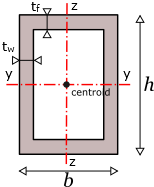
Rectangular and hollow rectangular sections
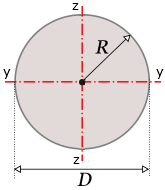
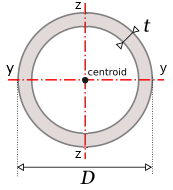
Circular and hollow circular sections
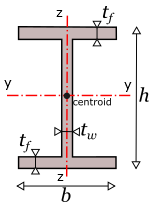
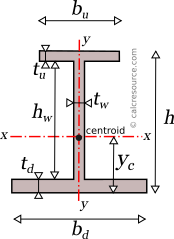
I-shapes and monosymmetric I-shapes
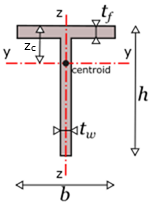
T-shapes
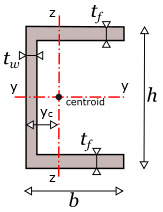
Channels
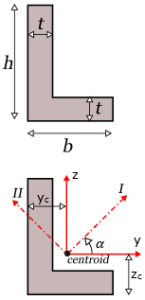
L-shapes or angles
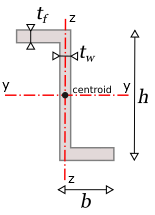
Z-shapes
Results are based on idealized geometry and assume no manufacturing tolerance, weld, or hole effects.
What Is Area Moment of Inertia and Why Does It Matter?
The area moment of inertia, also called the second moment of area, is a geometric property that describes how a cross-sectional area is distributed relative to a given axis. It depends on the shape and dimensions of the section, not on its material.
In structural engineering, moment of inertia is used to evaluate how a beam or section behaves under bending. A larger value means that more area is located farther from the selected axis, increasing the section’s resistance to bending deformation.
Why Engineers Care About Moment of Inertia
Moment of inertia is commonly used during beam pre-sizing, stiffness and deflection checks, and comparison of cross-sections. Engineers use it to estimate whether a section is sufficiently stiff for the expected span and loading and to compare its behaviour about the major and minor axes.
It is also used together with section modulus and radius of gyration in bending and stability calculations.
Calculator Functionality and Parameters
The calculator provides the following geometric and structural properties.
Geometrical Characteristics
Area A and perimeter P
Centroid coordinates Cy and Cz
Rotation angle of the principal axes θ
Moment of Inertia
For geometric axes:
Iy and Iz — moments of inertia about the Y and Z axes
Iyz — product of inertia
Ix — second polar moment of area
For principal axes:
I1 and I2 — moments of inertia about the major and minor principal axes
I12 — product of inertia about the principal axes
I3 — second polar moment in principal coordinates
Section Modulus, Radius of Gyration, and Shear Area
Zy, Zz, Z1, and Z2 — elastic section modulus
Sy, Sz, S1, and S2 — plastic section modulus
ry, rz, rx, r1, r2, and r3 — radii of gyration
Ay, Az, A1, and A2 — effective shear areas
Distances from the centroid to the extreme fibres
Torsional and Warping Properties
J — torsional constant
Cw — warping constant
Centroid Calculator
The centroid calculator determines the geometric centre of the selected cross-section. The centroid coordinates Cy and Cz are calculated automatically from the entered dimensions.
The centroid is used as a reference point for bending, stress distribution, load application, and other section-property calculations.
Section Modulus Calculator
The calculator provides elastic section modulus values Zy, Zz, Z1, and Z2 about the geometric and principal axes. It also calculates plastic section modulus values Sy, Sz, S1, and S2.
How Engineers Traditionally Calculate Moment of Inertia
For standard shapes such as rectangles, circles, and I-beams, engineers can use analytical formulas.
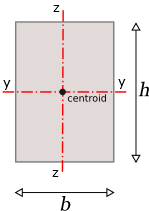
For a rectangle about its centroidal horizontal axis:
I = b × h³ / 12
For built-up sections such as I-beams, the section can be divided into simpler parts. The inertia of each part is calculated and transferred to the required axis using the parallel-axis theorem:
I = Ic + A × d²
Manual calculation is useful for understanding the fundamentals and verifying results, but it becomes time-consuming when dimensions change repeatedly.
Spreadsheet Templates
Spreadsheet templates allow engineers to enter dimensions and calculate properties using embedded formulas. They are useful for repeated calculations and comparison of alternatives.
However, spreadsheets must be updated for new geometries and can become unreliable if formulas, references, or units are changed.
CAD and FEA Software
CAD tools and FEA preprocessors can provide section properties after the geometry has been sketched. They are useful for irregular or asymmetrical geometry, difficult manual decomposition, or sections already being prepared for detailed modelling.
For a standard section, the engineer still has to open the software, create or edit the sketch, check the units, and extract the properties.
Why These Methods Slow Down Iteration
Manual formulas, spreadsheets, and CAD all work, but they require repeated updates when a flange thickness, web thickness, width, or height changes.
The engineer may need to update formulas, modify spreadsheet inputs, redraw a CAD sketch, recalculate the properties, and copy the values into another tool. This slows down comparison during concept design or quick validation.
Why CAD Is Overkill for Basic Section Calculations
CAD is a powerful design platform, but it is not always the most efficient tool for checking the moment of inertia or section modulus of a standard profile.
Opening CAD, creating geometry, checking settings, and generating a property report can take longer than the calculation itself. CAD also requires access to installed and licensed software.
For quick checks of standard shapes, a purpose-built browser calculator provides the required properties without the setup needed for a CAD model.
How to Use the Moment of Inertia Calculator
How to Use the Shape Calculator
Select the Unit System
Choose between Metric or Imperial (default is Metric).
Choose the Shape Type
Pick one of the available cross-section shapes:
Rectangular
Hollow Rectangular
Circular
Hollow Circular
I-Shape
T-Shape
Channel
L-Shape
Z-Shape
Monosymmetric l-shape
3. Enter the Shape Parameters
Fill in the required dimensions for your selected shape:
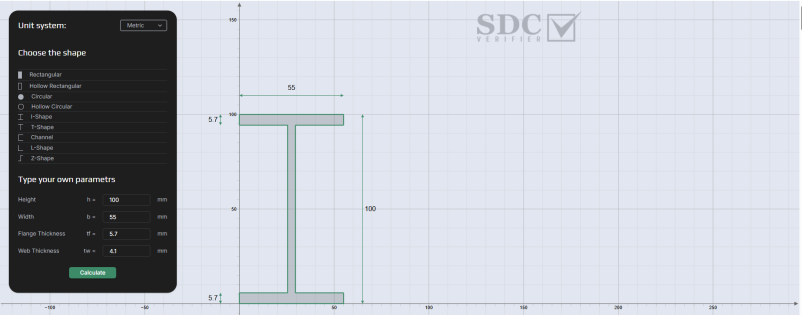
Height (h) – e.g., 100 mm/in
Width (b) – e.g., 55 mm/in
Flange Thickness (tf) – e.g., 5.7 mm/in
Web Thickness (tw) – e.g., 4.1 mm/in (Note: Parameter names may vary depending on the selected shape.)
4. Get Instant Results
The calculator will display detailed properties automatically.
5. Receive Results by Email
Enter your email to get the results sent directly to your inbox.
Example: I-beam Section Output
Let’s use the I-beam moment of inertia calculator to quickly determine section properties and evaluate the bending performance of a standard I-shaped profile.
Basic Properties
Height (h) = 100 mm
Width (b) = 55 mm
Flange thickness (tf) = 5.7 mm
Web thickness (tw) = 4.1 mm
Results:
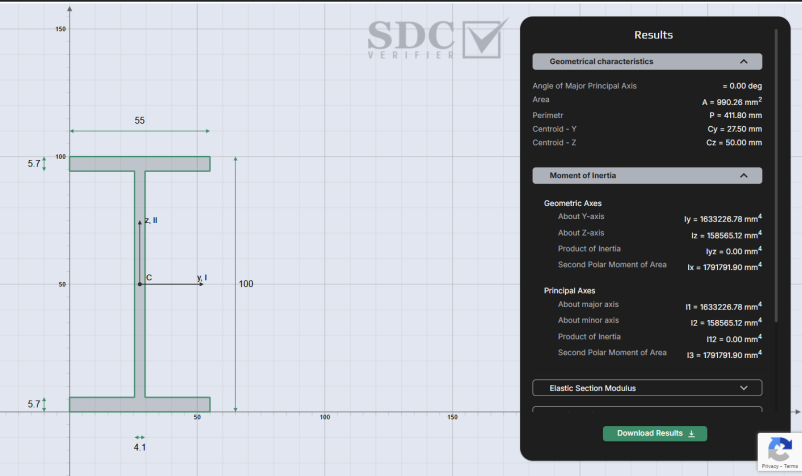
Geometrical characteristics
Angle of Major Principal Axis: 0.00°
Area (A): 990.26 mm²
Perimeter (P): 411.80 mm
Centroid Coordinates:
Y-axis (Cy): 27.50 mm
Z-axis (Cz): 50.00 mm
Moments of Inertia (Geometric Axes)
Moment of Inertia about Y-axis (Iy): 1,633,226.78 mm⁴
Moment of Inertia about Z-axis (Iz): 158,565.12 mm⁴
Product of Inertia (Iyz): 0.00 mm⁴
Second Polar Moment of Area (Ix): 1,791,791.90 mm⁴
Moments of Inertia (Principal Axes)
Major Axis (I₁): 1,633,226.78 mm⁴
Minor Axis (I₂): 158,565.12 mm⁴
Product of Inertia (I₁₂): 0.00 mm⁴
Second Polar Moment of Area (I₃): 1,791,791.90 mm⁴
Elastic Section Modulus
About Y-axis (Zy): 32,664.54 mm³
About Z-axis (Zz): 5,766.00 mm³
Major Axis (Z₁): 32,664.54 mm³
Minor Axis (Z₂): 5,766.00 mm³
Plastic Section Modulus
About Y-axis (Sy): 37,609.26 mm³
About Z-axis (Sz): 8,993.59 mm³
Major Axis (S₁): 37,609.26 mm³
Minor Axis (S₂): 8,993.59 mm³
Distances from Centroid to Extreme Fibers
Top Fiber: 50.00 mm
Bottom Fiber: 50.00 mm
Right Fiber: 27.50 mm
Left Fiber: 27.50 mm
Radius of Gyration
About Y-axis (ry): 40.61 mm
About Z-axis (rz): 12.65 mm
Polar Radius (rx): 42.54 mm
Shear Areas
About Y-axis (Ay): 522.50 mm²
About Z-axis (Az): 410.00 mm²
Major Axis (A₁): 522.50 mm²
Minor Axis (A₂): 410.00 mm²
Torsional and Warping Properties
Torsional Constant (J): 8,956.83 mm⁴
Warping Constant (Cw): 351,378,405.64 mm⁶
This example demonstrates how SDC Verifier’s moment of inertia calculator for free can be effectively used as a moment of inertia I-beam calculator to obtain accurate cross-sectional properties for structural analysis and design.
Formula for the Moment of Inertia of a Rectangle
Let’s calculate the moment of inertia of a rectangle with the following dimensions:
Width (b): 55 mm
Height (h): 100 mm
The moment of inertia (I) about any axis parallel to the centroidal axis is obtained by adding the centroidal moment of inertia to the product of the area and the square of the distance between the axes:
I= (b · h³) / 12
Substitute the given values:
Ix = (55 · 100³) / 12
Ix = (55 · 1,000,000) / 12
Ix = 55,000,000 / 12
Ix ≈ 4,583,333.33 mm⁴
Result of the calculation:
Ix ≈ 4,583,333.33 mm⁴
This value represents the moment of inertia about the centroidal axis (through the centroid). It’s a key parameter in assessing the bending resistance of a section.
Beyond Iy and Iz: Advanced Properties
Many basic calculators stop at area, moment of inertia, and section modulus. The SDC Verifier calculator also provides torsional, warping, and shear-area properties.
The second polar moment describes how the area is distributed around an axis perpendicular to the cross-section. The torsional constant J is a separate property used for torsion. For non-circular and open sections, the torsional constant is not the same as the polar moment of inertia.
The warping constant Cw is relevant for thin-walled open sections under torsion. Effective shear areas Ay, Az, A1, and A2 are used in shear calculations about geometric and principal axes.
Key Benefits of SDC Verifier’s Moment of Inertia Calculator
No Registration: Access all the features instantly without the need to sign up. Start calculating right away with full functionality.
Instant Results: Receive results in real time—quick, reliable, and accurate calculations without any delays.
Intuitive Interface: The user-friendly interface makes it easy to perform calculations, even for those with minimal technical experience.
Accuracy of Calculations: Calculations are based on analytical formulas from authoritative sources for standard shapes and assume ideal geometry.
What Can You Do After Receiving Results on Moment of Inertia?
Use the results for quick beam checks, comparison of section alternatives, preliminary calculations, or validation of values obtained from another source.
For detailed verification, SDC Verifier can calculate section properties and perform standard-based checks directly in an FEA model using standards including AISC, DNV, and Eurocode.
Verify Cross-Sections in FEA with Confidence
Calculate section properties and perform standard-based checks (AISC, DNV, Eurocode, etc) directly in your FEA model using structural design and analysis software SDC Verifier.
The moment of inertia is a measure of an object’s resistance to bending or rotation. In structural engineering, it’s used to determine how much a beam or section will deflect under load.
What is the section modulus?
The section modulus is a geometric property that represents the strength of a section in bending. It is calculated as the moment of inertia divided by the distance from the centroid to the outermost fiber.
What is the difference between lz and ly?
Iz is the moment of inertia about the Z-axis, while Iy is the moment of inertia about the Y-axis. The values depend on the geometry and orientation of the cross-section.
How to calculate polar moment of inertia?
The polar moment of inertia represents a cross-section’s resistance to torsion (twisting) about an axis perpendicular to the section. It is calculated in MOI calculator as the sum of the second moments of area about two perpendicular in-plane axes:
J=Ix+Iy
For standard shapes, this value is often provided directly by engineering tables or calculated using integration methods for complex geometries. It is a key parameter in evaluating torsional stiffness and rotational resistance of structural members.
What is area moment of inertia?
The area moment of inertia (also called the second moment of area) is a geometric property that describes how a cross-sectional area is distributed relative to a given axis. It quantifies a section’s resistance to bending rather than mass-based rotation.
It depends purely on shape and dimensions, not material properties, and is typically expressed in units such as mm⁴ or in⁴. Higher values indicate greater resistance to bending deformation, making it a fundamental parameter in structural design and beam theory.
Mass moment of inertia vs area moment of inertia?
Mass moment of inertia and area moment of inertia describe different physical behaviors.
The area moment of inertia is used in structural engineering and relates to bending resistance of cross-sections. It depends only on geometry and is the second moment of area calculator counts it in units like mm⁴.
The mass moment of inertia is used in dynamics and describes an object’s resistance to rotational acceleration. It depends on both geometry and mass distribution and is measured in kg·m².