
How SODIMEC verified a 198 t ladle lifting beam with SDC for Ansys
198
t lifting capacity verified
4
main checks performed
2
standards applied
- SODIMEC verified a ladle lifting beam for safe use at 198 t WLL under EN 13155:2020+A1, with EN 13001 requirements applied where relevant.
-
The project covered structural response, fatigue, weld behavior, and thermal effects.
- SDC for Ansys helped the team organize load cases and review results in one workflow.
To increase the Working Load Limit (WLL) of a steel ladle lifting beam to 198 t, SODIMEC needed a full structural verification under real service conditions. The beam is a non-fixed load lifting attachment, so the assessment was performed in line with EN 13155:2020+A1, with EN 13001 requirements considered where referenced by the standard.
This was not only a static strength problem. The team also had to account for thermal loading from the molten pig iron in the ladle, as well as fatigue over the expected number of load cycles. Using Ansys for the FE analysis and SDC for Ansys to organize load scenarios, review weld-related stresses, and process structural and fatigue results, SODIMEC verified the beam for safe use under the new 198 t WLL in the intended operating conditions.
Project at a glance
- Company: SODIMEC
- Structure: Ladle lifting beam / yoke
- Target WLL: 198 t
- Standards basis: EN 13155:2020+A1, with EN 13001 requirements where applicable
- Analysis workflow: SDC for Ansys
- Model size: 585,425 elements
- Checks performed: structural response, weld assessment, fatigue evaluation, thermal effects, and mechanical component checks
- Outcome: safe use of the lifting beam validated for the increased WLL under expected working conditions
The engineering challenge
The goal was to verify whether the lifting beam could safely operate at a higher 198 t WLL without falling outside the requirements of the applicable lifting-equipment standard.
The scope went beyond the main steel body. The team had to assess:
- required load cases for this type of lifting attachment,
- duty-cycle scenarios for fatigue assessment,
- weld-related behavior,
- thermal influence from the hot ladle below the beam.
The thermal effect was important. To meet the requirements, additional insulation had to be introduced in the heat protection plates.
How SDC Verifier was used in the project
SODIMEC built and solved the FE model in Ansys using a mesh of 585,425 elements. The results were then processed in SDC for Ansys as part of the verification workflow.

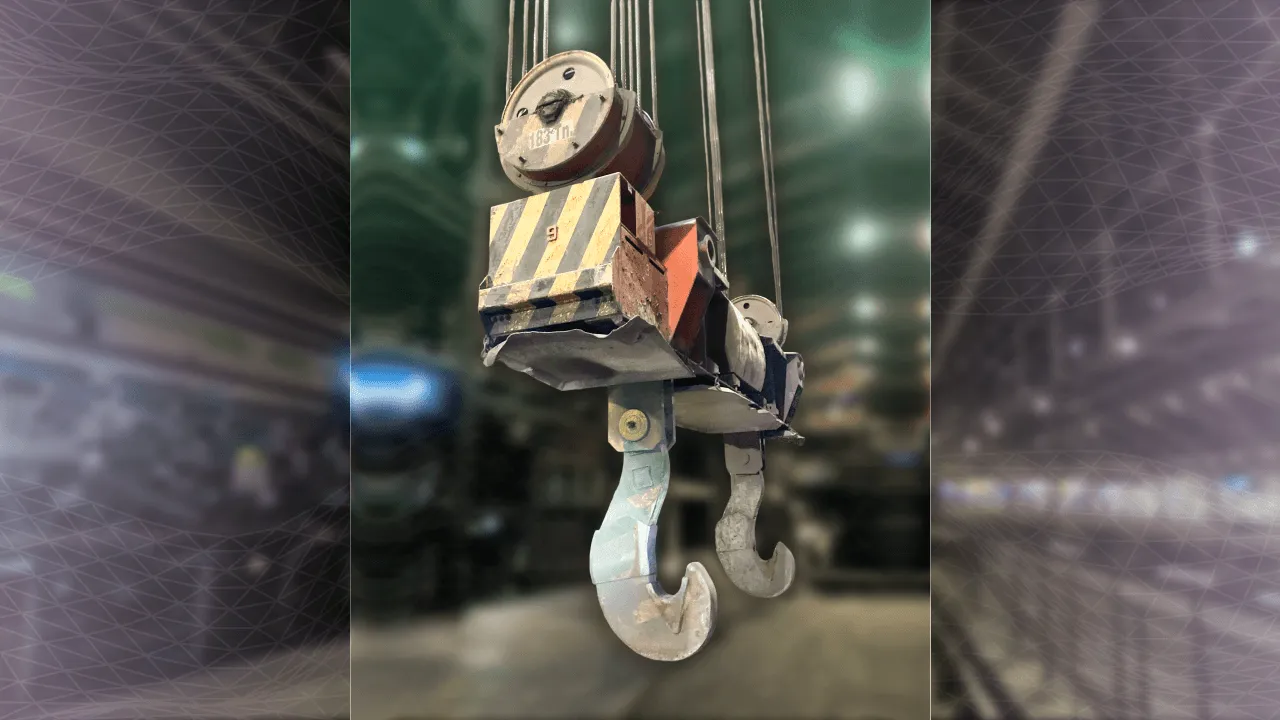
3D view of the ladle lifting beam verified in the project |

Mesh detail of the finite element model used for the ladle lifting beam verification |
The verification was performed against EN 13155:2020+A1, with EN 13001 requirements applied where relevant to fatigue and weld-related checks. Within this scope, SDC for Ansys was used to:
- organize required load scenarios through load case sets and groups,
- support weld-related checks with weld finder,
- review structural and fatigue results through its postprocessing workflow.
This allowed the team to handle multiple required load cases and service-cycle conditions in one workflow instead of reviewing them in separate manual steps.
After building the FE model and defining the required load cases, SODIMEC reviewed the global stress response of the beam. The plot below shows the equivalent stress distribution for a governing analysis case.

Equivalent stress distribution in the ladle lifting beam for a governing analysis case, reviewed in SDC for Ansys
Because the beam operates under repeated lifting cycles, fatigue assessment was also part of the verification scope. The plot below shows the stress-range result used to evaluate cyclic performance.

Stress-range result, reviewed in SDC for Ansys, used for fatigue assessment of the ladle lifting beam
In addition to the global structural response, SODIMEC also reviewed weld-related stresses as part of the same workflow. The plot below shows the weld stress result used for this assessment.

Weld stress distribution, reviewed in SDC for Ansys, used for weld verification of the ladle lifting beam.
Using SDC for Ansys, SODIMEC reviewed global structural response, fatigue-related stress ranges, and weld-related stresses as part of the same verification process.
Outcome
The project confirmed safe use of the ladle lifting beam at 198 t WLL under the expected working conditions and in line with the applicable standard requirements.
The verification also showed that the thermal protection concept needed an update: additional insulation in the heat protection plates was required for the design to comply.
From a workflow standpoint, SODIMEC reported these practical benefits from using SDC for Ansys:
- less engineering time spent on verification work;
- more detailed handling of required load cases, fatigue conditions, and weld-related checks;
- one structured workflow for reviewing the verification scope.