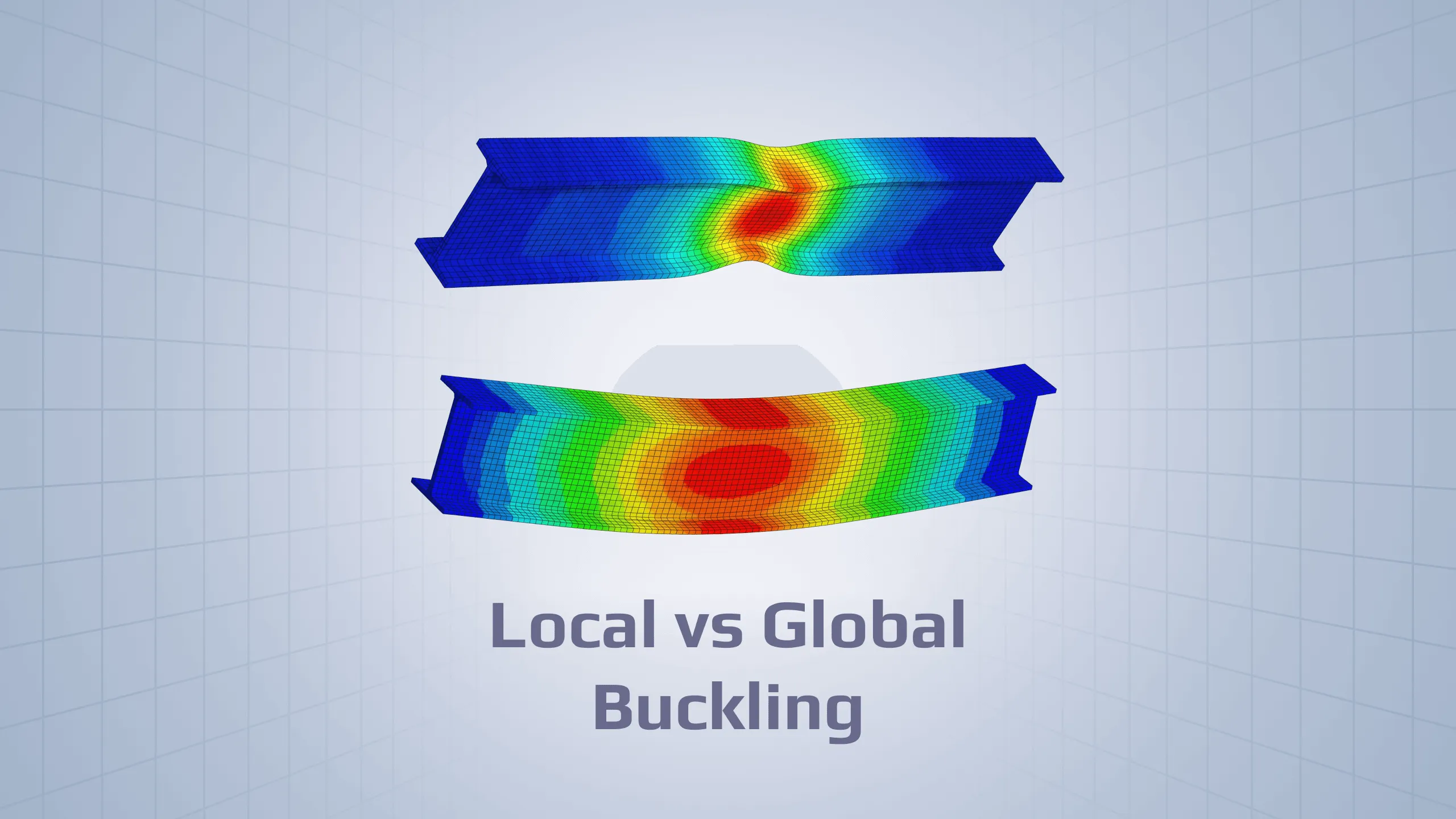
Requirement to check curved plate buckling: cylindrical shells in monopiles, pressure hulls, pipelines, tanks, and curved hull segments. These components behave differently from flat plates. While flat-panel rules such as DNV RP-C201 / CG-0128 assume zero curvature, DNV RP-C202 accounts for curvature R, membrane action, and combined axial, hoop, and shear loads that significantly influence buckling resistance.
Applying flat rules to shell-like regions often leads to non-conservative reserve factors, and local buckling in these curved sections is a frequent cause of redesign and project delays. Using the correct framework from DNV RP-C202 helps engineers identify issues early, maintain design accuracy, and avoid costly rework.
Curved Plating Is Different
Typical locations for curved plate buckling problems include:
Pressure hulls in submarines or semi-submersibles
Cylindrical tanks for oil, gas, and chemical storage
Curved hull sections on ships and offshore jackets
Pipe bends
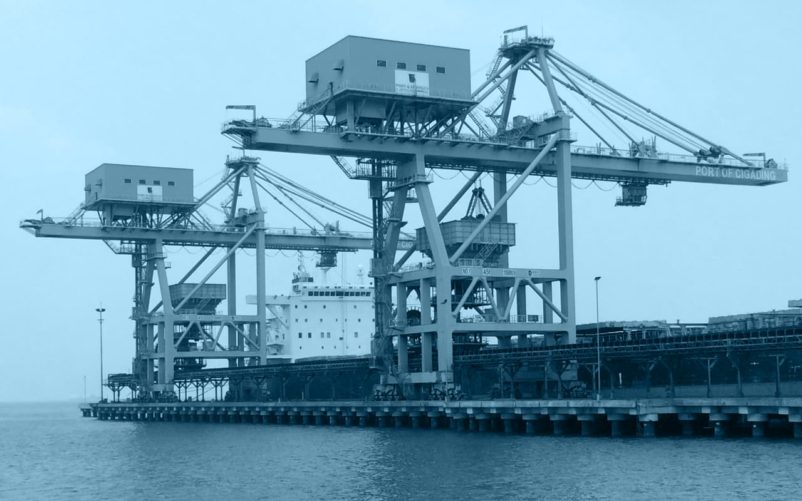
Image: Cargo ship in the seaport
The difference in mechanics between curved plate buckling and flat plate buckling is well documented in shell theory. As shown in classical shell theory and the Air Force “Stress Analysis Manual,” the buckling behavior of a curved plate depends strongly on the curvature ratio R/t and geometric parameters such as b²/(r·t). For very large radii (b²/(r·t) < 1), the panel may behave almost like a flat plate — and flat-plate formulas provide reasonable estimates.
Image: Buckling coefficient grouped according to r/t values for curved plates (source)
But as curvature increases, shell effects dominate, and the governing buckling stress follows modified formulations that incorporate curvature-dependent coefficients (e.g., C, kc, ks, η). Sharply curved panels or cylindrical shells (b²/(r·t) > 30–100) require dedicated relationships for axial and shear buckling, reflecting the significant variation of stiffness and stability as curvature increases.
In other words, a curved shell does not buckle the way a flat plate does. Curved panel buckling and cylindrical shell buckling follow different scaling with R/t and external pressure than flat plate buckling. It may carry more load — or fail earlier under different loading modes — depending on curvature, external pressure, stiffener layout, and boundary conditions. This is exactly why DNV RP-C202 separates curved plating from flat plate rules: to ensure engineers apply the correct assumptions, avoid unconservative design, and prevent late-stage rework caused by incorrect verification approaches.
When to Use DNV RP-C202 (vs C201/CG-0128)
Deciding whether to apply DNV RP-C202 (shell / curved-plate buckling) or DNV RP-C201 (flat-plate / stiffened-panel buckling) — or the guideline DNV CG-0128 — depends on the geometry, curvature and loading context of your structure. A practical rule: use C201/CG-0128 where panels behave as flat (or essentially flat) plates; use C202 when the geometry or loading makes shell behavior relevant.
These choices directly affect class approval, as classification societies typically refer back to C201 for plated structures C202 for shells.
When C201/CG-0128 is appropriate?
Structures with flat plates or stiffened panels, such as decks, bulkheads, flat bulkhead panels, and other near-planar elements.
Panels and stiffeners where local buckling under in-plane compression or shear is the dominant concern. C201 provides formulas for unstiffened and stiffened plates, stiffener buckling, and local stability checks within frameworks (girders, stiffened panels).
Where curvature is negligible and the structural behavior approximates that of a flat plate.
In such cases, buckling evaluation under C201 (or CG-0128, for broader classification rules) will cover in-plane compression, shear, stiffener buckling, and panel–stiffener interaction adequately. Standards like DNV in structural verification for ship design ensures accurate buckling checks and supports successful class approval.
Image: DNV plate buckling check results
When C202 should be used: curved or shell-like structures
DNV RP-C202 is designed specifically for curved plating and shells, cylindrical, conical, or other shell-shaped panels, where curvature significantly affects buckling behavior per DNVGL-RP-C202 ‘Buckling strength of shells’ (now DNV RP-C202). Key criteria for its use include:
Panels or shells with single curvature (e.g., cylindrical shells, conical shells) or curved panels between stiffeners.
Shell-shaped components subject to axial compression, external or internal (hydrostatic) pressure, lateral pressure, torsion, shear, or combined stress states. C202 defines elastic buckling strengths f_Ea (axial), f_Eh (hydrostatic / lateral / circumferential compression), f_Eτ (torsion/shear) for curved panels or unstiffened circular cylinders.
Panels where curvature cannot be neglected — i.e., geometry such that shell action is important, potentially altering critical buckling stresses compared to flat-plate assumptions.
What C202 Needs from You — and What You Provide in SDC Verifier
C202 relies on a clear set of inputs to evaluate shell buckling: geometry, curvature, stresses, lateral pressure, material data, and several calculation options that influence how stresses and dimensions are interpreted. SDC Verifier structures these inputs directly around the logic of DNV RP-C202 Section 3, which defines stability requirements, characteristic buckling strength, and elastic buckling strength for unstiffened curved panels.
Geometry and curvature.
SDC Verifier extracts the plate’s length, width, thickness, and radius using the Panel Finder. Length corresponds to the straight edge, width to the curved edge. These dimensions drive the selection between the two procedures in the code (Table 3-1 for l/w > 1, Table 3-2 for l/w ≤ 1) and affect all buckling coefficients and elastic strength calculations.
Image: Buckling coefficients table
Design resistance and material data.
The implementation computes f_ksd, the design shell buckling strength, based on Section 3.1–3.2. SDC Verifier automatically uses material yield/tensile values and internal material factors to form the final design resistance. The core verification is the utilization factor Uf = σ(j,Sd) / f_ksd, which must be ≤ 1 to fulfill the standard criteria.
Stresses and load effects.
SDC Verifier converts FE stresses into these directions and allows for choosing element stresses or plate-averaged stresses. Optional conservative settings include absolute shear for averaging. Lateral pressure is provided separately (not as an FE load): it is entered as a positive (internal) or negative (external) value, converted to circumferential stress (P·R/t), and combined with width-direction stresses per Section 3.2.
Boundary assumptions and panel recognition. The check follows C202 logic for unstiffened curved panels only. The Panel Finder defines plate boundaries and identifies curved edges; radius and width values are derived from the mesh, which delivers good accuracy even for coarse models. Panels with l/w ≤ 1 follow the procedure from Section 3.4.2 (cylindrical shell buckling), while bending and hydrostatic pressure coefficients are not included.
User-defined calculation options.
Thickness Factor (to modify t), Plate Average Stress, stress-type selection (average, elemental, or mid-plane), and the option to include plate dimensions in the results give users full control over both the conservatism and the documentation detail of the evaluation. The Thickness Factor enables plate-thickness reduction by multiplying the thickness of each plate, while the stress-type selection lets engineers choose which stress source is used in the calculation (e.g., average, elemental, or mid-plane).
The Pain of Manual Verification
Manual buckling checks can be frustrating and error-prone. Key challenges include:
Complex panel identification: Finding and defining curved panels in intricate models is tedious.
High risk of errors: Calculating parameters like R/t ratios, stresses, and buckling coefficients manually is prone to mistakes.
Time-consuming reporting: Preparing documentation for class approval or audits takes a lot of effort and can slow project timelines.
Low traceability: Tracking calculations and results for verification or future reference is difficult.
Example: Verifying a cylindrical tank shell manually involves calculating lateral pressure stresses, buckling coefficients, and slenderness for every panel. Although this work can take days when done manually, it can be automated quickly using structural analysis software, SDC Verifier.
How SDC Verifier Automates DNV RP-C202 Curved Plate Checks
SDC Verifier streamlines DNV RP-C202 curved plate buckling checks by fully automating the identification, classification, and buckling checks of curved panels and unstiffened circular cylinders.
1. Using the Panel Finder tool, the software automatically detects all panels in a model, including curved or custom-shaped sections, without the user having to manually define or track each panel.
Image: Panel Finder Tool window in SDC Verifier
2. Add load combinations per DNV RP-C202 requirements.
3. Once detected, panels are classified according to DNV RP-C202 requirements, and the software calculates buckling coefficients, elastic and characteristic buckling strengths, and stress utilization factors for axial, hoop, bending, shear, torsion, and lateral pressure loads. Every step of the calculation references the relevant clauses of DNV RP-C202, providing full transparency so engineers can trace results back to the standard.
Image: DNV RP-C202 standard check window in SDC Verifier
4. Finally, SDC Verifier he report is automated and can be regenerated in minutes when there are some model updates.
Image: Report after plate buckling check, generated by SDC Verifier
This automation not only saves time but also significantly reduces errors, ensuring confident compliance with DNV RP-C202.
See the whole DNV Plate Buckling Check workflow in SDC for Ansys extension by this video on our YouTube channel:
Result Interpretation and Design Optimization
A clear understanding of results is essential for safe and efficient structural verification. Engineers often face recurring issues, such as:
Using the wrong standard or load scenario
Incorrect boundary conditions
Ignoring external pressure effects
Mixing up member-based vs plate-based checks
Misaligned principal directions
Misinterpreting load and factor combinations
SDC Verifier minimizes these risks by visualizing utilization ratios directly on the model, allowing engineers to instantly identify overstressed areas and understand critical failure points.
Early detection accelerates design optimization, cuts rework, and reduces costly redesign cycles. All checks are fully auditable and can be exported for reports and project documentation, ensuring traceability and compliance throughout the engineering workflow.
Conclusion
Mastering the fundamentals of curved plate buckling — and applying them consistently — is key to preventing design errors, avoiding rework, and ensuring structural safety. Automating these checks with SDC Verifier’s implementation of DNV RP-C202 streamlines the entire process, reduces manual effort, and delivers reliable, repeatable results.