Shipyard cranes operate under heavy loads, repeated lifting cycles, and aggressive marine conditions. That makes fatigue one of the main design risks, especially in welded details, abrupt structural transitions, and other local stress concentration areas.
This case study shows how SDC Verifier was used inside an FEA workflow to assess and validate the fatigue performance of a shipyard crane according to EN 13001-3-1+A2. The goal was not to manually spot-check a few details, but to verify the full model systematically across relevant weld details and realistic cyclic loading conditions.
Run crane fatigue checks directly on top of your FEA model
See how SDC Verifier helps engineers identify fatigue-critical welded details, assign code-based fatigue categories, and verify shipyard crane structures according to EN 13001-3-1+A2.
Shipyard crane structures include many fatigue-sensitive details and familiarweld fatigue challenges: welded joints, bolted connections, corners, transitions, and local geometry changes. In service, these details are exposed to repeated stress variation from lifting and lowering operations. In a marine environment, that structural demand is compounded by humidity, salt exposure, and temperature changes.
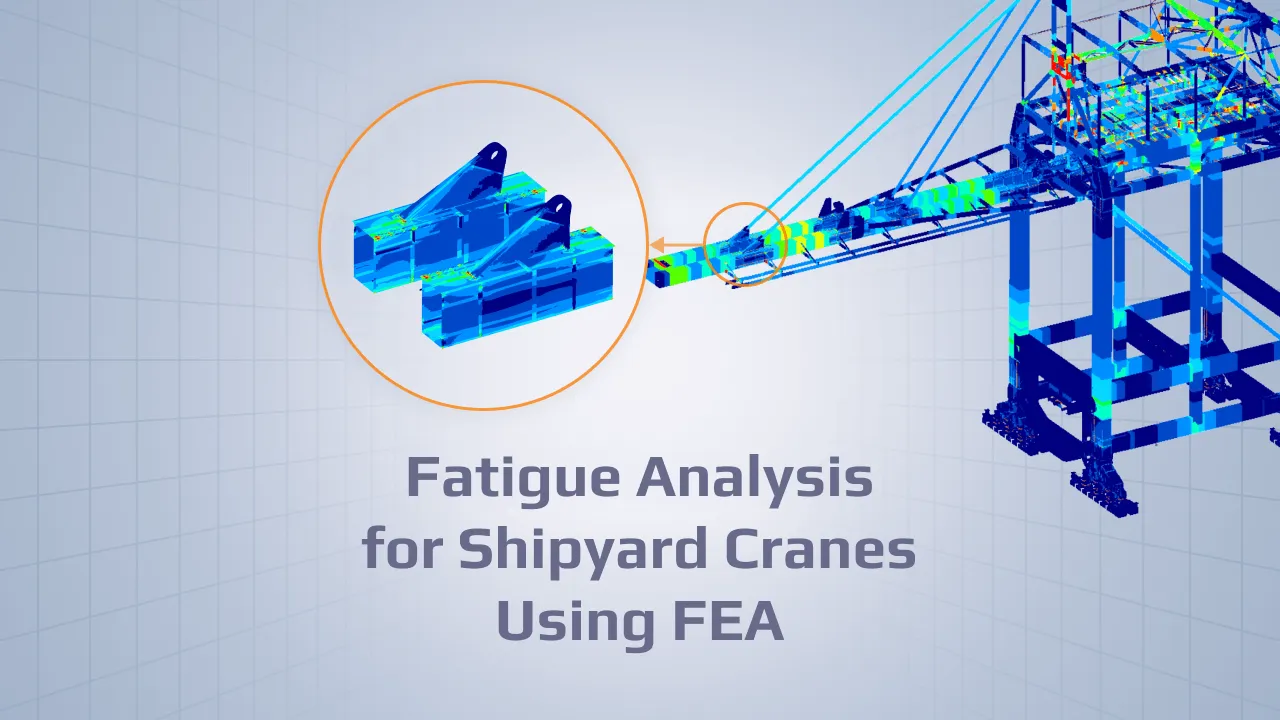
The result is predictable: some areas of the structure carry much higher fatigue risk than others. Stress analysis of the crane highlighted local stress concentration zones, especially around areas with elevatedweld stressesand abrupt structural transitions, such as plate thickness changes and structural interfaces. These are the places where fatigue cracks are most likely to initiate if the design is not checked properly.
Figure 1. Global stress distribution in the shipyard crane FE model, highlighting areas selected for follow-up fatigue assessment in SDC Verifier.
The limitation of manual fatigue verification
An engineer can performresidual life analysis for crane structuresor fatigue calculations manually in Excel, Mathcad, or similar tools. But that approach breaks down quickly when the model includes many structural members, many welded details, and many loading conditions.
Manual methods are workable when one member is checked under one loading condition. They are not efficient when the task is to verify a complete crane model under hundreds or thousands of combinations on top of the general FEA design workflow.
That is where SDC Verifier changes the process. It turns fatigue verification from a fragmented post-processing exercise into a repeatable engineering workflow integrated with the broader structural assessment process.
Fatigue Analysis Workflow: FEA Model and EN 13001-3-1+A2
A finite element model of the crane was prepared with special attention to critical welded connections. The FE model was built primarily with shell elements representing the mid-surfaces of the structural plates, together with material data and local mesh refinement in fatigue-sensitive areas. Because the model was shell-based, weld effects were not represented by explicit 3D weld volume. Instead, SDC Verifier introduced weld behavior analytically through weld recognition and fatigue category assignment according to EN 13001-3-1+A2.
The crane boom connection zone was then extracted from the full FE model for more detailed fatigue assessment. This made it possible to concentrate mesh refinement and fatigue classification on the most critical subcomponents without losing the context of the full structure.
Extracted crane boom connection zone from the global FE model, used for detailed fatigue assessment in SDC Verifier.
The applied cyclic loads represented the crane’s operating conditions.
The fatigue verification was performed according toEN 13001 crane verificationand specifically EN 13001-3-1+A2. The analysis used the Direct Use of Stress History approach for fatigue strength assessment, while the Stress History Parameter was calculated automatically in SDC Verifier. Where needed, the workflow could also follow the Simplified Method, allowing the user to define stress history parameters independently.
Material data and fatigue parameters were assigned in line with the standard. This included fatigue category selection, slope constant, reduced stress range, and the fatigue strength specific resistance factor where required by the detail category and inspection conditions.
Detail type
Representative fatigue category
Description
Base material
180
Non-welded structural material used as the reference case
Continuous weld, quality level B
180
Weld detail in the most favorable classification case
Continuous weld, quality level C
140
Standard continuous weld detail
Weld toe at structural transition
80
Local detail at an abrupt transition requiring more conservative fatigue assessment
Table 1. Representative fatigue categories for welded details considered in the EN 13001-3-1+A2 workflow
How SDC Verifier supported the fatigue check
One of the main practical advantages in this project was automation.
Based on FEA stress results and principles used in thehot spot stress method for weld evaluation in FEA, SDC Verifier automatically identified fatigue-relevant locations such as weld toes, welded-part interfaces, and abrupt structural transitions. The software also distinguished between welded parts, base plates, and other fatigue-sensitive details so that the correct fatigue categories could be assigned consistently across the model.
For each relevant hotspot, the corresponding fatigue category and S-N curve were applied to estimate fatigue life. In practice, that meant evaluating the same connection detail in separate stress directions and assigning fatigue strength according to the governing local condition. Small geometric changes at welded details can materially change the fatigue life prediction, which is exactly why automatic recognition and consistent category assignment matter.
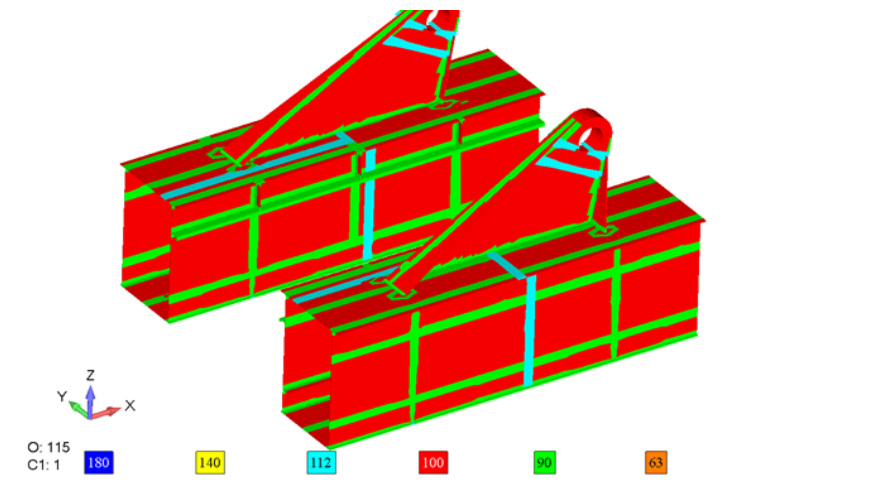
Figure 3. Fatigue classification of the crane boom connection zone in the Y-direction, showing how welded details and structural transitions receive different fatigue categories under EN 13001-3-1+A2.
Figure 4. Fatigue classification of the same crane boom connection zone in the X-direction, showing how the assigned fatigue categories change with detail orientation and local weld configuration.
Figure 5. Governing fatigue classification of the crane boom connection zone based on the most critical result from the separate X- and Y-direction checks.
Where the crane details were exposed to variable-amplitude loading, SDC Verifier used the Palmgren-Miner linear damage rule to evaluate cumulative fatigue damage. The software also accounted for factors that materially affect fatigue life, including stress history and surface condition. Instead of leaving that accumulation to manual spreadsheets, SDC Verifier handled it automatically across every identified hotspot in the model.
Results and design validation
The results showed that fatigue performance was not uniform across the crane.
The main girder, loaded primarily in vertical bending, demonstrated fatigue life comfortably above the required design life. By contrast, several connection zones showed lower fatigue margins because local weld geometry and biaxial stress concentrations increased damage in more than one stress direction.
The downstream fatigue results confirmed the same pattern. The critical locations were not spread broadly across the structure; they were concentrated at specific connection details, welded interfaces, and local structural transitions.
Fatigue damage contour plots confirmed the same pattern. Damage accumulation remained localized around the more critical weld-related details rather than being distributed broadly across the structure, which made it clear where engineering attention was required.
Figure 6. Fatigue damage distribution across crane boom weld details, showing localized hotspots identified by SDC Verifier.
A broader fatigue-life view of the boom showed the same engineering story: the overall structure remained within acceptable limits, while a small number of local connection details governed the fatigue assessment.
Figure 7. Global fatigue-life distribution across the crane boom, showing localized critical hotspots at connection zones against an otherwise acceptable structural response.
The analysis findings supported practical engineering decisions:
some details were accepted as designed,
some required a weld quality upgrade,
and some were redesigned through local geometric modification.
That is why model-wide fatigue verification matters. A crane can look acceptable at the global level while still containing local details that control fatigue life.
Why SDC Verifier is more practical than manual fatigue checking
An experienced engineer can calculate fatigue manually in Excel, Mathcad, or similar tools. But that approach usually works for one member under one loading condition at a time. In a shipyard crane, where multiple welded details must be checked across many operating cases, that quickly becomes slow, inconsistent, and error-prone.
Running directly within your FEA environment, SDC Verifier helps engineers:
verify complete crane models instead of isolated details,
process hundreds or thousands of loading combinations in one workflow,
apply EN 13001-3-1+A2 fatigue checks more consistently,
The result is not just faster fatigue analysis. It is broader coverage, more repeatable verification, and a lower chance of missing the local details that govern fatigue life.
Run fatigue checks directly on top of your FEA model
Use SDC Verifier to perform EN 13001-compliant fatigue checks for crane structures, welded details, and other fatigue-sensitive components. Start a free trial or book a technical demo to see how SDC Verifier handles crane fatigue verification on top of your FEA model.
This shipyard crane case shows why fatigue verification should not be treated as a disconnected manual exercise.
In welded crane structures, the governing details are often not the obvious ones. Fatigue risk is local, load-history-dependent, and easy to underestimate if the workflow is fragmented. By combining FEA results with automated fatigue checks in SDC Verifier, engineers can identify critical hotspots faster, apply EN 13001 requirements more consistently, and validate fatigue performance across the full structure with less manual effort.
For crane design teams working onheavy lifting structures, that means a more reliable and scalable verification process from FEA results to final design sign-off.