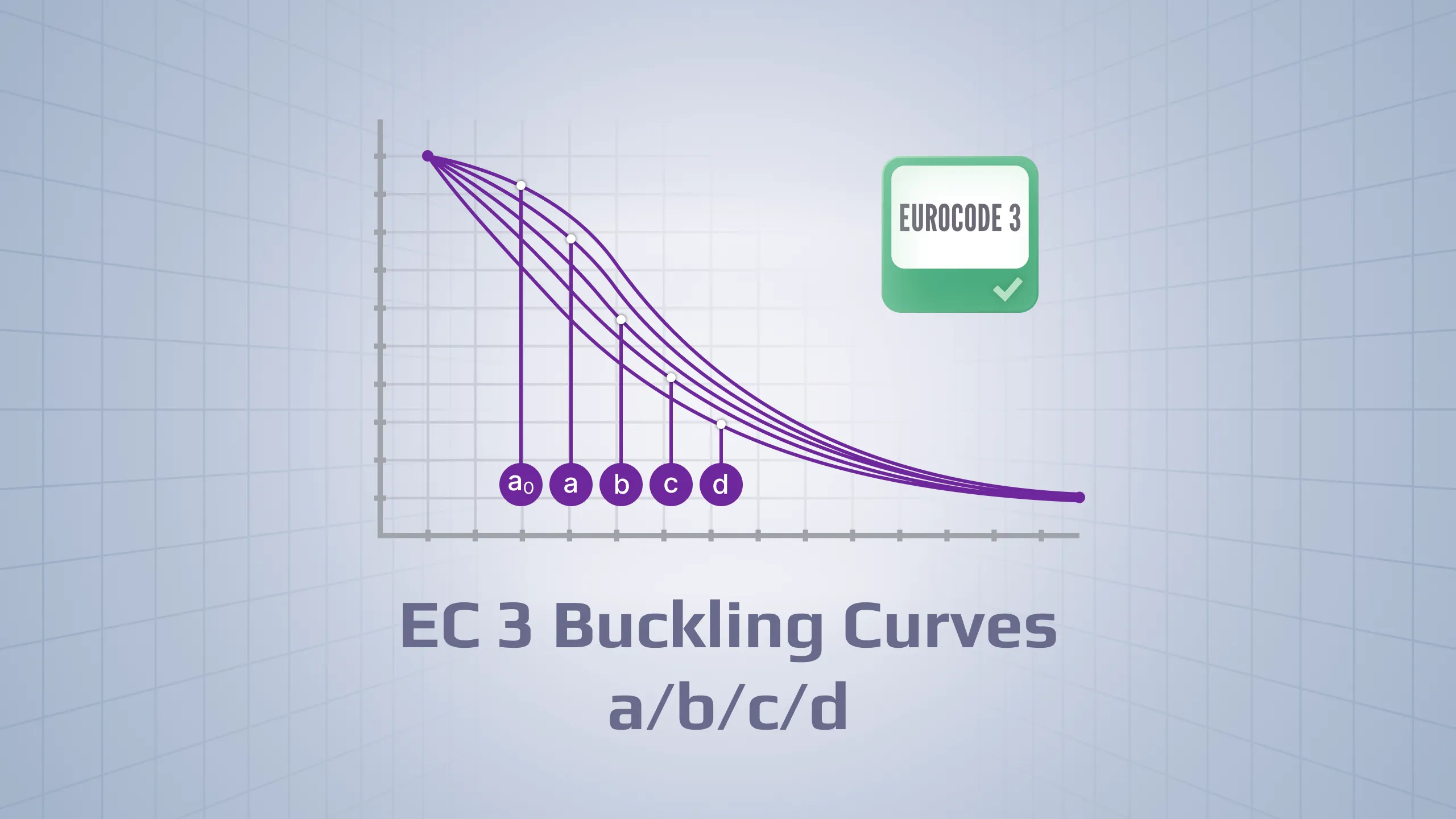
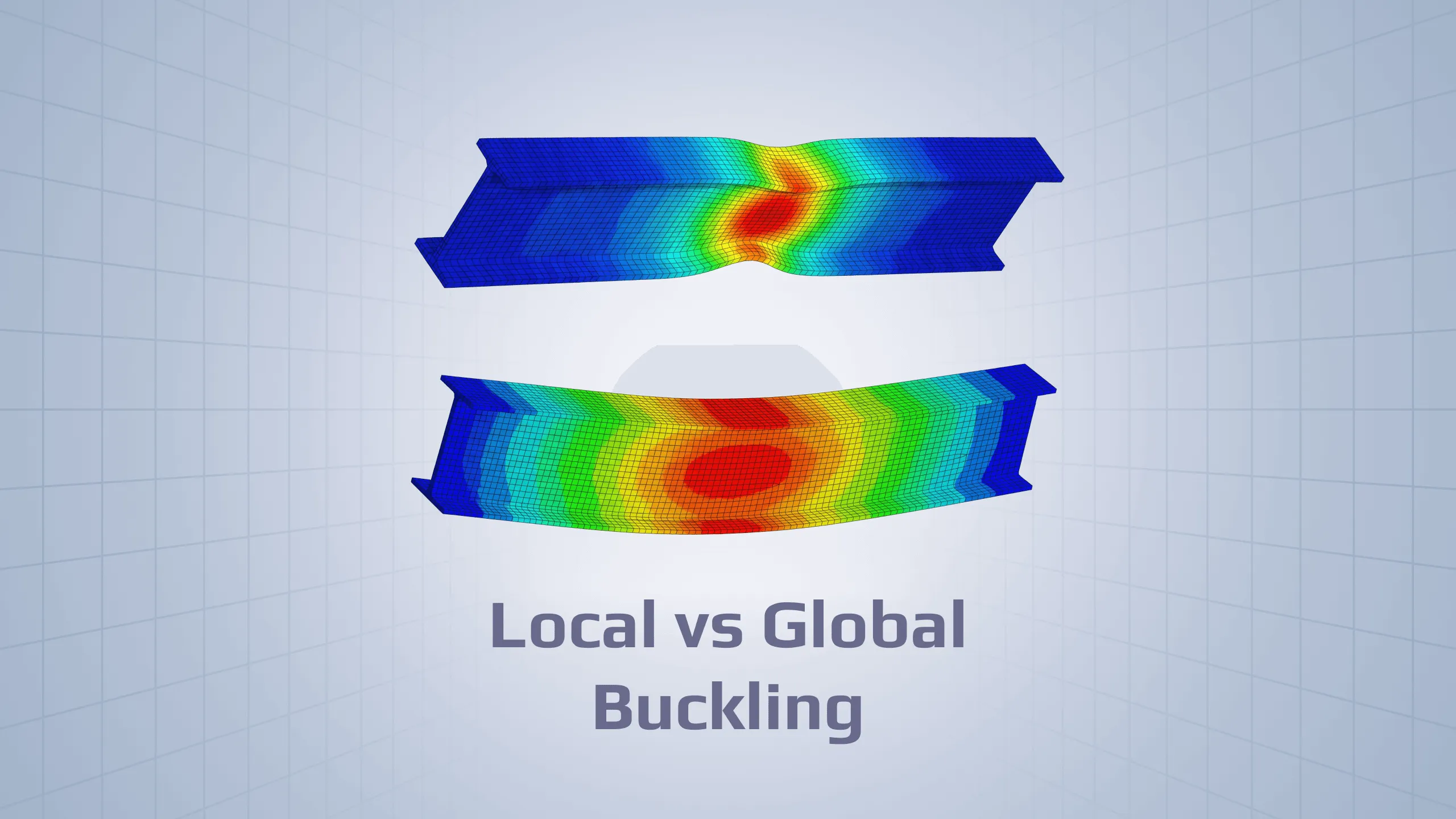
EC3 buckling curves exist to account for real-world imperfections and residual stresses that apply to flexural buckling of compression members (member stability). EC3 defines four curves, a, b, c, d, representing different imperfection levels and fabrication conditions.
In this article we use three key symbols: λ̅, α, χ.
λ̅ — non-dimensional slenderness, representing the member’s susceptibility to global buckling. α — imperfection factor, defining the selected EC3 buckling curve. χ — reduction factor, reducing the cross-section resistance to account for buckling.
This article explains each curve, how to interpret slenderness, χ, and buckling direction, and shows how tools like SDC Verifier make EC3 global buckling checks more repeatable and less error-prone.
Why Do EC3 Buckling Curves Exist?
In theory, a steel member in compression is perfectly straight and free of residual stresses, but in reality all beams and columns contain initial curvature, eccentricities, and fabrication-induced stresses from rolling, welding, or cold forming. These imperfections cause buckling to occur at loads lower than the ideal elastic critical force Ncr . The value of Ncr depends on the effective buckling length, the buckling axis (major or minor), and the boundary conditions, such as pinned, fixed, or partially restrained supports.
Eurocode 3 buckling curves account for this gap between theory and practice by introducing reduction factors (χ) that reduce the theoretical resistance according to member slenderness and imperfection sensitivity—meaning that more slender members and those with higher fabrication imperfections retain less usable resistance.
Each curve (a, b, c, d) in EC3 represents a different level of imperfection sensitivity, quantified through the imperfection factor α, which is calibrated against experimental test results:
Global buckling in Eurocode 3 describes the loss of stability of an entire member, not the failure of its cross-section. In global buckling checks, it is assumed that local stability has already been verified through cross-section classification (Classes 1–4) and, where required, by using effective section properties. For compression members and beam-columns, EC3 distinguishes between several global buckling modes, each governed by member geometry, restraints, and loading.
Flexural, torsional, and flexural–torsional buckling
The most common global instability mode is flexural buckling, where a member bends laterally about its strong or weak axis under axial compression, governed by the elastic critical force Ncr for the relevant buckling direction and effective length. Buckling curves a–d are for flexural buckling in compression. Torsional / flexural–torsional uses the governing Ncr but curve assignment is still per Table 6.2. For open or monosymmetric sections, EC3 also requires checks for torsional and flexural–torsional buckling, where twisting or combined bending–twisting may govern at lower critical loads; the most unfavorable Ncr must always be used when determining slenderness and resistance.
Slenderness λ and non-dimensional slenderness λ̅
Buckling behavior is primarily driven by slenderness. In EC3, it is expressed through the non-dimensional slenderness λ̅, which compares the plastic or elastic resistance of the cross-section to the elastic critical buckling force:
A low λ̅ means a stocky member where buckling is unlikely.
A high λ̅ means a slender member where global instability governs.
λ̅ increases when Ncr is low (long member/weak restraints) or when resistance is high.
Imperfection factor α — the heart of the curves
The imperfection factor α is what differentiates buckling curves a, b, c, and d. It represents how sensitive a member is to real-world imperfections such as initial curvature and residual stresses.
In practical terms:
Lower α (curve a / a₀) → rolled, symmetric sections with favorable behavior
Higher α (curve c / d) → welded, cold-formed, or less stable configurations
What determines the buckling curve for a member
The applicable curve is determined by several physical and geometric characteristics:
Fabrication method: rolled vs. welded or built-up members
Cross-section type: open I/H sections, channels, angles, hollow sections
Buckling axis: y-y or z-z direction
Buckling direction and governing mode (for flexural vs torsional buckling)
Material grade
The Four EC3 Buckling Curves (a, b, c, d)
EC3a, b, c, and d,curves translate initial curvature, residual stresses, and fabrication effects into the design reduction factor χ, which reduces the theoretical member resistance to a realistic value.
Buckling Curve
Imperfection Factor (α)
Performance Level
a₀
0.13
Excellent (Highest resistance)
a
0.21
Very Good
b
0.34
Good
c
0.49
Fair
d
0.76
Poor (Lowest resistance)
Curve a and a₀ – Low imperfection, high resistance
What it represents: Members with minimal initial imperfections, such as hot-finished hollow sections or carefully rolled I-sections, are highly stable. Buckling occurs closer to the ideal elastic critical load.
Typical shapes: Hot-finished hollow sections, some symmetric rolled sections.
Imperfection factor α: Low (≈0.13–0.21), resulting in minimal reduction of strength.
Practical effect on χ: Because α is low, χ remains close to 1.0 even for relatively slender members, meaning the member retains most of its theoretical capacity.
Curve b – Moderate imperfections
What it represents: Commonly used for rolled I- or H-sections, accounting for moderate residual stresses and slight initial curvature.
Curve selection depends on axis: Welded L-shape (depending on the flange thickness), rolled unsymmetrical shapes such L section.
Imperfection factor α: Medium (≈0.21–0.34).
Practical effect on χ: χ decreases faster with increasing slenderness than curve a, reflecting slightly more conservative design for global buckling.
Curve c – Higher imperfections
What it represents: For welded built-up sections or members prone to higher fabrication-induced imperfections. Buckling is more sensitive, so allowable axial or flexural load is reduced more aggressively.
Typical shapes: Unsymmetrical U and T section, circular or rectangular bar.
Imperfection factor α: High (≈0.49), producing significant reduction in χ.
Practical effect on χ: χ drops quickly as λ̅ increases, meaning slender welded members must be carefully checked for global stability.
Curve d – Very high imperfections
What it represents: Sections with high imperfection sensitivity, often welded built-up members, depending on the buckling axis and fabrication method. Buckling resistance is significantly reduced compared to elastic predictions due to residual stresses and geometric imperfections.
Typical shapes: Some built-up welded sections with thin flanges or web elements, large-span slender structures.
Imperfection factor α: Very high (≈0.76).
Practical effect on χ: χ decreases sharply even at moderate slenderness, enforcing strong conservatism in member checks.
How Reduction Factors Are Calculated
In EC3, the reduction factorχ is the mechanism that converts theoretical buckling strength into usable design resistance.
Step 1: From member geometry to slenderness
The process starts with slenderness. Using the member’s length, boundary conditions, cross-section stiffness, and material strength, Eurocode 3 evaluates how prone the member is to buckling compared to yielding. This is expressed through the non-dimensional slenderness λ̅.
Short, stocky members → low λ̅ → buckling is unlikely
Long, slender members → high λ̅ → buckling dominates
Step 2: Applying imperfection sensitivity
Next, EC3 introduces the imperfection factor α, selected through the appropriate buckling curve (a–d). This factor represents how strongly real-world imperfections—initial curvature and residual stresses—affect the member.
Conceptually, EC3 combines:
λ̅ (how slender the member is), and
α (how imperfection-sensitive the member is)
to determine how much the ideal resistance must be reduced. Members with higher α values lose capacity faster as slenderness increases.
Step 3: Obtaining the reduction factor χ
The output of this process is the reduction factor χ, which always lies between 0 and 1:
χ ≈ 1.0 → buckling effects are negligible
χ ≪ 1.0 → buckling strongly governs the design
What χ means for design resistance
In practical EC3 member checks, χ directly reduces the resistance:
Axial compression resistance is multiplied by χ
For beams, LTB uses χ_LT and α_LT. LTB is a separate check; it’s analogous but not the same curves.
A utilization close to 1.0 often indicates that global buckling, not cross-section strength, is controlling the design.
Common failure modes governed by buckling reduction
Reduction factors typically govern:
Slender columns in axial compression (flexural buckling)
Beam-columns where axial force and bending interact
Welded or built-up members with higher imperfection sensitivity
EC3 Member Checks (Compression, Bending, Combined)
EC3 member checks are performed after cross-section classification, which directly affects how buckling is evaluated. For Class 1–3 sections, global buckling checks use gross section properties. Class 4 sections, however, are those in which local buckling occurs before the cross-section reaches yield, so effective section properties must be used.
EC3 treats global instability through separate checks:
Axial compression buckling, governed by flexural (or torsional / flexural–torsional) buckling and reduced by the factor χ.
Lateral–torsional buckling for beams in bending, governed by the reduction factor χ_LT based on the elastic critical moment Mcr .
When members are subjected to combined axial force and bending, Eurocode 3 uses interaction formulas (EN 1993-1-1 §6.3.x) to ensure that compression and bending effects are considered together in a consistent and conservative way. These combine axial and bending utilization; you don’t ‘pick a curve’ for the interaction; curves enter via the buckling resistances. The result of these checks is typically expressed as a utilization ratio.
How SDC Verifier Automates EC3 Buckling Curves
Image: Model from buckling check
Structural analysis software, SDC Verifier automates the EC3 buckling workflow by translating Eurocode logic directly into the verification process, while still keeping key engineering assumptions transparent and controllable.
The software performs automatic cross-section classification and assigns the appropriate buckling curve in accordance with EN 1993-1-1, Table 6.2. SDC Verifier software proposes curve based on section type/fabrication/axis; engineer should verify (especially for non-standard built-ups and NA settings). You already do this for Ly/Lz/Lt – mirror that caution here. Major and minor axes are correctly identified, ensuring that the governing buckling direction is evaluated consistently with the section geometry.
Ly/Lz/Lt are effective buckling lengths about each axis; changing them changes Ncr → λ̅ → χ. This ties everything together.
Beam Member Finder
Image: Beam member finder window
Using the Beam Member Finder, SDC Verifier automatically determines effective buckling lengths Y, Z axis of cross section, and Lt based on member connectivity, end releases, and partial restraints. These directions correspond to the strong and weak axes of the member, which are crucial for accurate calculations, and SDC Verifier determines them automatically. These effective lengths directly influence slenderness and resistance; therefore, engineers retain the ability to review and override Ly/Lz/Lt where the numerical model does not fully represent real support conditions.
From these inputs, SDC Verifier computes non-dimensional slenderness λ̅, selects the relevant imperfection factor α, and evaluates the reduction factor χ. The governing axis and buckling length are clearly indicated, allowing engineers to understand which instability mode controls the design.
All results are presented in full member check reports, including ULS buckling verifications and governing load combinations, providing traceable reports for reviews and audits.
Practical Tips for Engineers
Be conservative with uncertain fabrication
For unknown fabrication quality, hybrid built-ups, heavily welded members, heat-affected zones, thin webs/flanges, or non-standard geometries, avoid optimistic buckling assumptions.
Default to more conservative buckling curves unless fabrication tolerances and residual stress levels are clearly justified – pick curve d.
Always check both principal axes
Do not assume major-axis buckling governs.
Minor-axis buckling frequently controls, especially for slender members, open sections, and members with weak out-of-plane restraint.
Understand why welded built-up sections often correspond to higher imperfection curves (c or d)
Welded sections exhibit higher residual stresses and geometric imperfections.
These effects reduce buckling resistance, which is why EC3 typically assigns welded members to buckling curves c or d rather than a or b.
Avoid common buckling misconceptions
“Curve a is always safe” — incorrect; it applies only to specific hot-rolled sections with favorable residual stress patterns.
“Buckling curve choice has minor impact” — incorrect; curve selection can significantly change χ and the final utilization.
“If axial utilization is low, buckling is irrelevant” — incorrect; slenderness and effective length can still govern.
Always validate modeling assumptions
Buckling results are only as reliable as the assumed restraints and effective lengths.
Review Ly/Lz/Lt carefully, especially where real supports differ from idealized FE boundary conditions.
Conclusion
Eurocode 3 buckling curves may appear complex at first glance, but at their core they are a practical way of translating real-world imperfections into reliable design resistance. By understanding the roles of slenderness, imperfection factor α, and reduction factor χ, engineers can clearly see why different members follow curves a, b, c, or d—and how global instability governs many steel designs long before cross-section strength is reached.
Modern verification tools remove much of the manual effort and uncertainty from this process. By automatically classifying sections, selecting the correct buckling curves, identifying governing axes and effective lengths, and reporting transparent ULS results, software SDC Verifier allows engineers to focus on engineering judgment rather than code mechanics.
Learn more about EC3 Member Checks in SDC Verifier