How SDC Verifier software supports code-compliant buckling checks
Buckling is often treated as a single failure mode, but in reality, local vs global bucklingrefers to two distinct instability mechanisms. Local buckling affects individual plates or elements within a cross-section, while global buckling refers to instability at the member level, such as a column, beam, or brace.
Mixing up the difference between local and global buckling can lead to unsafe designs or unnecessary conservatism. Local buckling reduces the stiffness of a section, and design checks account for this by using a reduced effective section, whereas global buckling, such as flexural buckling or lateral torsional buckling (LTB), can govern the ultimate resistance of a member. It still reduces resistance and must be verified; it’s not ‘allowed’ just because it looks local. Design standards therefore address these phenomena separately.
Local buckling is the localized displacement or “wrinkling” of a thin plate element within a cross-section (such as a flange or a web) when subjected to compressive stress. Local buckling occurs when compressive stress in a plate element reaches a critical value dependent on b/t and edge restraint. Physically, it occurs when a plate element can no longer sustain compressive stresses and deforms out of plane, while the overall member may remain stable and capable of carrying load. Local buckling is governed by the slenderness of individual plates within the cross-section, primarily flange and web width-to-thickness ratios, plate proportions, and boundary conditions.
Typical examples of local buckling include:
Flange or web buckling in I-sections and box sections
Thin-walled box and plate elements subjected to compression or shear
Panel buckling between stiffeners, common in offshore and marine structures
Panel buckling is described as local at the structure level but global at the panel level (the whole panel participates, but only within the plating bay). For example, panel buckling between stiffeners is local to the hull or plating system, governed by plate dimensions and stiffener spacing, even though it involves the full panel width.
How Standards Check Local Buckling
Design standards address local buckling by accounting for the loss of effectiveness of slender plates before global member stability is verified.
Eurocode 3 (EC3)
In EN 1993-1-1, local buckling at cross-section level is addressed through cross-section classification (Classes 1–4), based on the width-to-thickness ratios (c/t or b/t) of individual plate elements (flanges and webs) under the relevant stress distribution.
Classes 1–3 are considered non-slender. Local buckling is not expected to reduce the section’s capacity before the relevant limit of state (plastic, elastic, or yield resistance, depending on the class).
Class 4 sections contain slender plate elements that may buckle locally before reaching yield stress.
For Class 4 sections, EC3 applies the effective width / effective section method (with reference to EN 1993-1-5 for plate buckling rules). Effective properties increase slenderness to lower χ/χ_LT to higher utilization. Slender plate elements are reduced to effective widths that represent their post-buckling resistance. This leads to reduced effective area and effective section properties (A_eff, I_eff, W_eff).
DNV and ABS (for Marine and Offshore)
DNV and ABS standards address local buckling more explicitly through plate and panel buckling checks. They often use direct plate/panel buckling formulations, these rules assess the stability of individual plates and stiffened panels based on:
Plate dimensions and thickness
Geometry properties like ratio of width to length, etc.
Stiffener spacing and rigidity
Boundary conditions and load type
When Local Buckling Becomes a Global Problem
Local and global buckling are distinct phenomena, but they are mechanically linked through section stiffness and resistance. Local plate buckling does not directly cause member instability; instead, it reduces the effective cross-section, which in turn affects global stability behavior.
When slender flanges or webs buckle locally, part of the compressed plate becomes ineffective in carrying stress. In design terms, this leads to:
Reduced effective area (A_eff)
Reduced effective moment of inertia (I_eff)
Possible shift of the neutral axis
Reduced torsional properties can also affect LTB
These reduced properties directly influence global checks such as flexural buckling and lateral torsional buckling. The global stability formulas themselves do not change, the buckling curves, interaction equations, and reduction factors remain the same. The member check format stays the same; inputs and sometimes resistance terms change via effective properties. What changes are the input section properties used in those formulas. As a result, a member that appears safe based on gross properties may fail once effective properties are applied.
This is precisely why standards require separate but sequential verification. Local buckling must be assessed first (cross-section class or plate buckling), and only then can global member stability be evaluated using the reduced section. The separation ensures physical consistency, while the sequence ensures that global resistance reflects the true, post-local-buckling behavior of the member.
What Is Global Buckling?
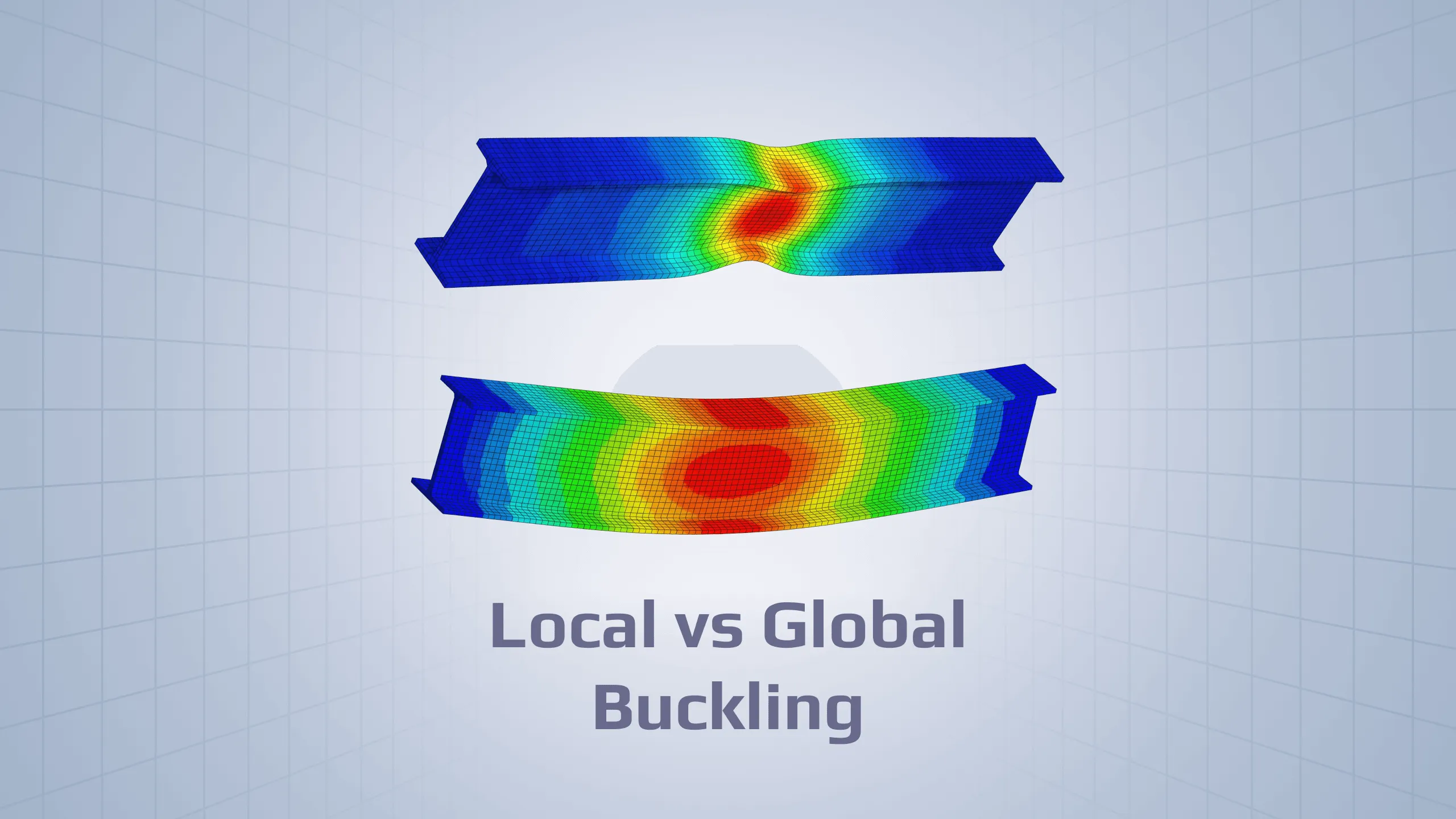
Image: Comparison of global and local buckling in FEA (source)
Global buckling is an instability of the entire structural member, not just individual plates within its cross-section. It occurs when a compressed or bent member loses overall stability and deforms in a global mode shape governed by its span, support conditions, and load distribution.
Unlike local buckling, global buckling is controlled by:
Member length
Boundary conditions and restraint
Load path and loading type
Load eccentricity and material/geometrical imperfections
Global buckling checks use effective length factors (e.g., Ly, Lz = effective buckling lengths, Lt = torsional/unbraced length parameter) and assume that local stability has already been addressed through cross-section classification or plate buckling verification. The member is therefore evaluated using gross or effective section properties, depending on whether local buckling reduces the section.
Common Global Buckling Modes
Column-type global buckling:
Flexural buckling – lateral deflection about the weak or strong axis under axial compression
Torsional buckling – pure twisting instability, typically relevant for open or monosymmetric sections
Flexural-torsional buckling – combined bending and twisting, common in thin-walled or asymmetric sections
Beam-type global buckling:
Lateral torsional buckling (LTB) – instability of a beam under bending, involving lateral displacement of the compression flange combined with twist
How Standards Verify Global Buckling
Global buckling is verified at member level by reducing the cross-section resistance through buckling reduction factors (χ) derived from member slenderness and imperfection models.
EN 1993-1-1
In EC3, axial compression members are checked using buckling curves a, b, c, d, which apply specifically to flexural buckling under axial load. The reduction factor χ is calculated from the non-dimensional slenderness and the corresponding imperfection factor (α).
For lateral torsional buckling (LTB), EC3 uses a separate reduction factor χ_LT, based on an imperfection factor α_LT and the non-dimensional slenderness for LTB. Although the format is similar to axial buckling, LTB does not use curves a–d. Instead, i LTB uses χ_LT based on M_cr and unbraced length; it does not use curves a–d, and optional correction factors (e.g., k_c) depending on the selected method.
AISC 360
AISC 360 standard verifies global stability using column and beam strength curves derived from calibrated inelastic and elastic buckling formulations. Axial compression (Chapter E) transitions between inelastic and Euler buckling regions, while LTB (Chapter F) depends on unbraced length, M_cr-equivalent formulations, and the modification factor C_b. The approach differs numerically from EC3 but follows the same principle: reduced strength based on slenderness.
Terminology differs: EC3 uses χ and curves a–d; AISC uses strength curves and factors.
Join our newsletter
Stay updated with the latest in structural verification, engineering insights, and SDC Verifier updates.
Please enter a valid email address.
Local vs Global Buckling — Comparison Table
Parameter
Local Buckling
Global Buckling
Typical SDC Verifier Checks
Scale of instability
Plate, panel, or cross-section element (flange/web); localized.
Entire member (column, beam, brace); global mode.
Local: EN 1993-1-5 plate buckling; DNV/ABS plate & panel buckling; Panel Finder
Global: EN 1993-1-1 members; AISC members; ISO/API members
A_eff, I_eff, radius of gyration, χ / χ_LT factors.
Standards treatment
Section class & effective width (EC3); direct plate rules (DNV, ABS, LR, BV).
Member stability clauses with χ factors / buckling curves (EC3, AISC).
Local → plate utilization.
Global → member utilization incl. χ.
Structural consequence
Reduces effective section/stiffness; usually not total failure.
Loss of full member capacity;possible collapse.
Clear separation of plate vs member checks to avoid double counting.
How Structural Verification Software Helps to Identify Local vs Global Buckling
Finite Element Analysis (FEA) eigenmodes alone are not sufficient for code verification: they identify potential modes but do not apply safety factors, imperfections, or design resistances. So, verification software must translate FEA results into code-based stability assessments, clearly separating local and global phenomena. That’s what structural analysis software SDC Verifier does.
Local Buckling Checks in SDC Verifier
SDC Verifier addresses local buckling at both cross-section and panel levels:
Cross-section classification (EC3 Classes 1–4) based on plate slenderness ratios
Effective section properties for slender (Class 4) elements
Using the Panel Finder, SDC Verifier automatically identifies plates and stiffened panels from the FE model, determines their dimensions and thicknesses, and feeds them into plate/panel buckling checks. their dimensions and thicknesses, and feeds them into plate/panel buckling checks.
Plate buckling checks handle local plating behavior.
Effective section reduction handle local member element slenderness.
Image: Automated Plates Detection in FEA Model
Also, in SDC Verifier, Beam Member Finder and Joints Finder automatically recognize all member lengths required for beam buckling checks.
Global Buckling Checks in SDC Verifier
For member-level instability, SDC Verifier performs:
Global verification uses gross or effective section properties (depending on local results) and applies:
Reduction factors (χ, χ_LT)
Buckling curves (a/b/c/d in EC3) (a–d apply to flexural buckling in axial compression; LTB uses χ_LT)
Code-specific column or beam strength formulations
SDC Verifier can automatically propose a buckling curve based on cross-section type, fabrication method, and buckling axis. However, engineering judgment remains essential — the designer should review and override the selection where necessary (e.g., non-standard weld detailing, national annex requirements, or atypical restraint conditions).
The Most Common Buckling Misinterpretations Engineers Make
Using incorrect effective length/unbraced length assumptions (Ly/Lz/Lt).
Assuming FEA eigenmodes replace code checks: Eigenmodes results do not include safety factors, imperfections, or design resistances.
Using Class 1–3 formulas for Class 4 sections: Slender sections require effective properties before member checks.
Treating panel buckling as a member problem: Plate instability is governed by local slenderness, not member length.
Believing “no dramatic mode shape = no buckling risk”: Real structures buckle with imperfections at lower loads.
Ignoring cross-section classification: Section class determines whether gross or effective properties must be used.
Calling local buckling “acceptable deformation” without verification: It reduces stiffness and resistance and must be checked per code.
Conclusion
Local and global buckling are fundamentally different instability mechanisms and must be treated separately in design. Standards clearly define how local plate behaviormodifiessection properties before global member stability is verified. Relying on intuition or eigenmodes alone is not sufficient for compliance or safety. A structured, standards-based workflow ensures physically consistent results. SDC Verifier supports this process by separating and automating both local and global buckling checks within one transparent verification framework.
Run the same workflow in your model
Use SDC Verifier to verify local plate behavior (plate/panel buckling) and global member stability (member buckling/LTB) in one traceable workflow.