Designing lifting appliances requires more than checking peak stresses against a yield limit. The governing question is usually fatigue: how stress varies between its extremes, how the mean stress shifts the allowable range, and whether the connection detail is realistic for the required number of load cycles.
This article turns into a practical stress-interpretation guide for cranes and hoisting structures, focused on what to read in FEA results, what to compute, and what engineers commonly misread.
At the heart of lifting appliances like cranes design is the analysis of stress variation. Engineers must look beyond static limits and consider how stress fluctuates between its highest and lowest points during operation.
Stress extremes, average stress, and κ (kappa): the three numbers that drive the check
To evaluate a cyclic stress state, you need the two extremes and two derived ideas:
Maximum stress (σₘₐₓ)
Minimum stress (σₘᵢₙ)
Stress variation: the difference between maximum and minimum stress
Average stress: the “middle” level of the cycle
And a key ratio used by lifting appliance methods:
Stress ratio (κ): κ = κ=σ∣max/σmin, where σ∣max is the largest absolute stress in the cycle.
Why the “absolute maximum” matters: the largest stress magnitude can be either tensile or compressive. If compression has the larger magnitude, the absolute maximum is compressive and becomes the reference value in κ. Misreads often start when engineers use plain signed max/min without checking magnitudes.
Two quick sanity examples:
If a component cycles between load and no-load: σₘᵢₙ = 0 → κ = 0.
If stresses change sign with nearly equal magnitudes, the case is close to fully reversed → κ ≈ −1.
Tension vs compression and the mean-stress effect
Lifting appliance methods typically use different allowable-stress curves for tension and compression and account for mean stress by slightly reducing the allowable stress variation as the mean stress increases.
That’s why two cases with the same (Δσ) can have different allowable: the cycle position (mean stress) and whether the dominant extreme is tensile or compressive matters.
What Stress Components Actually Govern in Lifting Appliances
Engineers often misread fatigue checks because they treat “stress” as a single scalar value. In real FEA results, the governing stress state depends on (1) the stress component type, (2) the direction relative to the detail (especially welds), and (3) where the extreme occurs (surface/corner).
Top vs bottom surface stresses: don’t read only one side
In plate/shell results, stresses are reported separately on the top and bottom surfaces. The governing extreme for a cycle can occur on either surface. If you only inspect one side (or only report a single “equivalent” value), you can miss the governing extreme and misread the stress variation.
Corner values matter
A single plate element can produce different results at different corners, and separately on top and bottom surfaces. That means you can have multiple candidates for (σₘₐₓ) and (σₘᵢₙ) even within one element.
If you compare allowable against a single picked stress (e.g., one surface at one corner), you may be checking a non-governing extraction—and the utilization can flip once you evaluate all candidate extremes consistently.
Weld-related stress states: shear vs normal, and direction matters
For weld detail classification, what governs is not just magnitude but the type and direction of the stress state:
Shear-dominated locations behave differently from normal-stress-dominated locations.
For normal stresses, direction relative to the weld line influences the appropriate detail category and the resulting allowable.
This is exactly where engineers misread results: they apply an optimistic notch group to a stress state that is not shear-dominated, or they ignore that a perpendicular/parallel stress orientation changes the classification logic.
Fatigue Design and Connection Classification
Fatiguecan dominate the design of a lifting appliance. Ignoring it canreduce allowable stresses drastically compared to simple yielding limits.
Lifting appliance standards classify details into notch groups (often K0 to K4) to represent fatigue sensitivity due to stress concentration.
The practical takeaway is brutal: detail selection and execution quality can dominate allowable stress, sometimes more than the base material.
Typical detail examples that push notch groups down
Connection geometry and fabrication choices are the usual culprits:
Fillet weld arrangements in critical load paths often drive the detail to the lowest categories.
Backing strips typically constrain how far you can “upgrade” the fatigue category without changing the detail.
Crossing details (where load must “turn a corner” through welded intersections) tend to be fatigue-critical.
Abrupt thick-to-thin transitions create strong stress raisers and frequently end up in low notch groups.
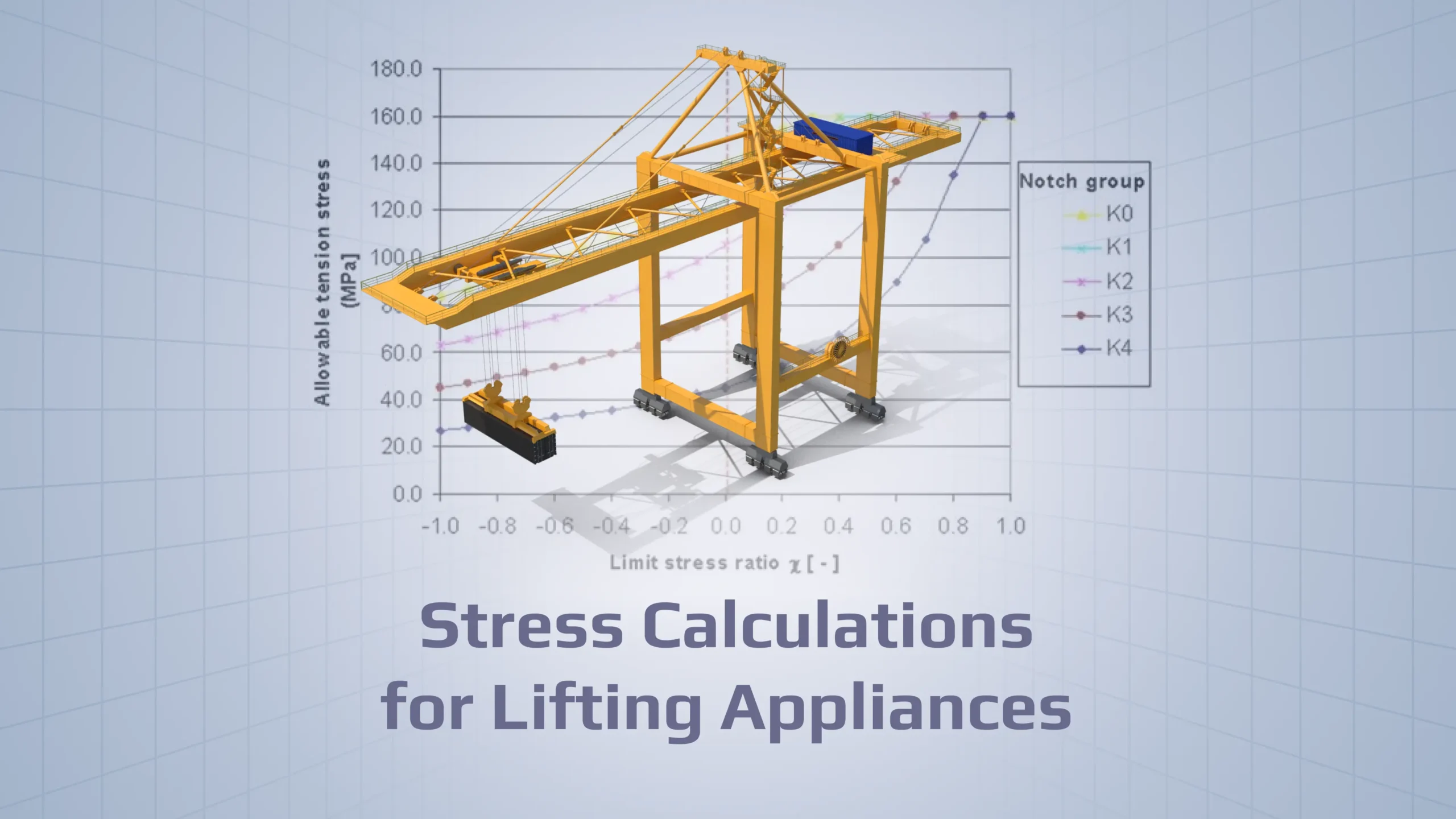
In high-cycle usage (e.g., around 2 million load cycles), poor details can push allowable stress ranges down to the tens of MPa. That is why a “K4-like” detail can drop allowable stress to around 45 MPa, far below a typical yield limit (e.g., 160 MPa). In extremely fully reversed cases, allowable stress ranges can drop even lower (e.g., around 27 MPa).
Image: Illustration of allowable fatigue stress in k0-K4 notch groups
Why Weld Quality and Geometry Matter
Quality work pays off because it reduces stress concentration:
Avoid fillet welds in crossing and high-cycle locations when possible.
Avoid abrupt thick-to-thin transitions; use smooth transitions and generous radii.
Treat backing strips as a fatigue category limiter unless the detail is redesigned.
These are not “after-the-fact checks.” They are design inputs: if you want to design a certain stress level, you must choose a detail category that makes that stress level achievable.
What engineers often misread
1) Miscomputing κ by using signed max/min instead of the absolute maximum
κ must be based on the largest absolute stress in the cycle. If the largest magnitude is compressive, it becomes the reference. Using casual signed max/min can place you on the wrong κ-case and change the allowable stress significantly.
When stresses swing between tension and compression with similar magnitudes, the check becomes sensitive. Small numerical changes in extremes can flip the governing sign case and produce noticeable jumps in utilization.
If you see jumps near κ≈−1, treat it as a signal to:
Fatigue damage is not always evaluated as “one stress number.” In lifting appliance methods, damage is typically evaluated by direction, with each directional damage required to stay below its limit, and a combined limit applied across directions (often expressed as a cap on the summed effect).
This can lead to counterintuitive behavior: tension in one direction and compression in another can worsen the combined result compared to what a single-scalar reading would suggest.
Plate, beam, and solid models don’t behave the same in classification
Model type influences how you should interpret stress and classification:
Plate/shell models are often the cleanest for lifting appliance checks, because you can work consistently with surface stresses (top/bottom) and apply the detail classifications used by lifting appliance methods.
Beam models can be efficient, but classification must reflect how connections are represented, because connection geometry and load transfer may be simplified.
Solid/volume models introduce a practical issue: geometric stress concentration can be captured directly by geometry and mesh. This makes “plate-style” classification less straightforward, and you need a consistent internal rule set for how detail categories are assigned when stresses already include geometric concentration effects.
Practical Application and Automation
Manual stress variation checks are possible, but in real models they are time-consuming and error-prone.
A single plate element has:
stresses on top and bottom surfaces,
values at multiple corners,
and governing extremes that may occur in different locations across different load cases.
The engineering problem is consistency: extracting maxima and minima correctly everywhere, computing κ consistently, and applying the correct detail category logic across the structure.
Standards like Eurocode 3 and EN 13001 provide detailed procedures involving load cycles. However, the “beauty” of the lifting appliance method is the ability to directly qualify a connection in the design phase. Once the classification, material, and crane group are known, the allowable stress can be determined quickly using standardized curves.
Using SDC Verifier for Efficiency
Image: Checks result in SDC Verifier software
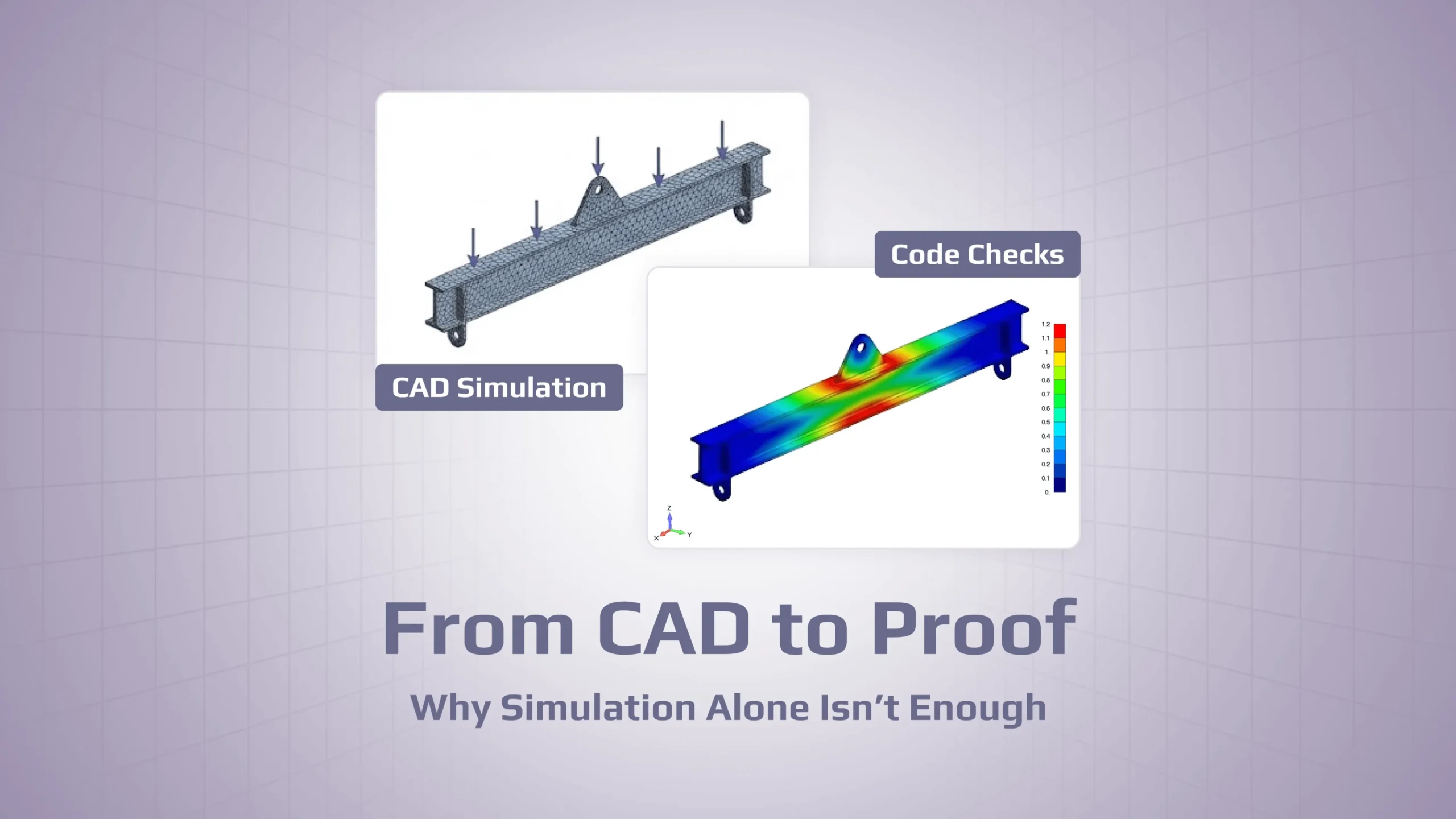
Calculating stress variations for every element in a complex model is a massive undertaking; a single plate element can have eight maximum and eight minimum stress values across its corners and surfaces. Structural analysis software, SDC Verifier, automates this extensive “number crunching” by systematically extracting stresses directly from FEA results and evaluating them against the relevant code-based acceptance criteria.
SDC Verifier performs detailed stress utilization checks for plates, stiffeners, and welds, including membrane, bending, and combined stress components, ensuring that governing stress states are correctly identified. The software applies the appropriate classification automatically—whether K3 for default welds, K0 for shear-dominated locations, or other stress categories defined by the selected standard—eliminating manual interpretation and reducing the risk of misclassification.
All stress checks are executed consistently across the entire structure, producing clear pass/fail results, utilization ratios, and color-coded visualizations that immediately highlight critical areas. This enables engineers to quickly trace governing stresses back to their physical locations, validate assumptions, and optimize designs with confidence.
By automating stress checks and standard compliance, SDC Verifier not only accelerates verification workflows but also delivers transparent, audit-ready documentation, supporting efficient design iterations and reliable decision-making in complex structural projects.
Conclusion
Stress checks for lifting appliances are not about chasing a single “max stress” value. The reliable approach is to interpret stresses as cycles:
extract (σₘₐₓ), (\σₘᵢₙ), (Δσ), (σₘ), and κ correctly,
treat plate stresses as a top/bottom surface problem,
respect that weld classification and geometry can dominate allowable stress,
watch for κ≈−1 sensitivity and multi-direction damage combination.
Used this way, lifting appliance standards become a practical design guide: they tell you what details are required to achieve a target stress level under the expected number of load cycles.