Frequency analysis in engineering is essential for understanding systems’ dynamic behavior. This guide will cover the basics of frequency analysis, its applications in design, and its significance in engineering decisions. We will also explore key concepts such as natural frequencies, resonance, and single-degree and multiple-degree-of-freedom systems. By the end of this article, you will have a clearer understanding of how frequency analysis is used to ensure system reliability and performance.
Understanding Frequency Analysis
Frequency analysis is crucial in engineering because it provides insights into how systems respond to dynamic forces such as vibrations, oscillations, and periodic loads. It is not merely about how a structure reacts to any load but specifically about how it behaves under varying dynamic conditions. Whether analyzing vibrations in mechanical parts or ensuring structural integrity under fluctuating loads, frequency analysis allows engineers to predict potential issues like resonance or fatigue.
The Basics
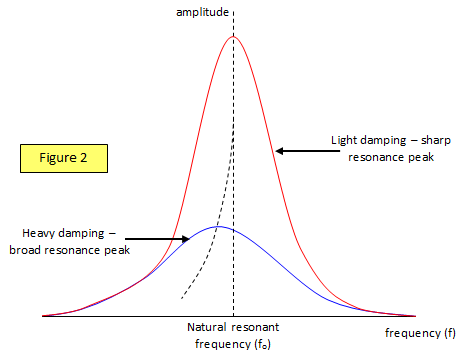
In essence, frequency analysis involves studying how a system’s response varies with different input frequencies. One of the most important concepts is a system’s natural frequency — the frequency at which a system tends to oscillate in the absence of external forces. When the frequency of an applied force matches the system’s natural frequency, resonance occurs, which can lead to large oscillations and potential failure.
Image:schoolphysics.co.uk; This graph demonstrates how light damping leads to a sharp resonance peak, while heavy damping results in a broader, less intense peak. Engineers use damping techniques to control these peaks and prevent structural failure due to resonance.
Engineers often use mathematical tools such as the Fourier Transform to break down complex signals into their frequency components, making it easier to analyze how different parts of a system interact dynamically. This analysis helps engineers adjust the system to improve performance, avoid resonant conditions, and enhance reliability.
How Natural Frequencies Are Calculated
For a simple single-degree-of-freedom system, the natural frequency depends primarily on the system’s stiffness and mass. It can be calculated using:
$$f_n = \frac{1}{2\pi}\sqrt{\frac{k}{m}}$$
where f_n is the natural frequency in Hz, k is the stiffness in N/m, and m is the mass in kg. For example, if a system has a stiffness of 10,000 N/m and a mass of 100 kg:
This calculation shows how changes in mass or stiffness affect the natural frequency: increasing stiffness raises the natural frequency, while increasing mass lowers it.
For real-world structures with multiple degrees of freedom, the calculation becomes a matrix eigenvalue problem involving the structure’s mass and stiffness matrices:
$$[K]\phi = \omega^2[M]\phi$$
where K is the stiffness matrix, M is the mass matrix, Ω is the natural angular frequency, and φ represents the corresponding mode shape. In FEA, solving this eigenvalue problem provides the natural frequencies and corresponding mode shapes used to characterize a structure’s dynamic behavior.
Usage of Frequency Analysis in Design
Frequency analysis is a fundamental tool across multiple engineering disciplines:
Structural Engineering: In structural design, it is used to identify natural frequencies and avoid resonant conditions that could amplify vibrations and lead to structural fatigue or failure.
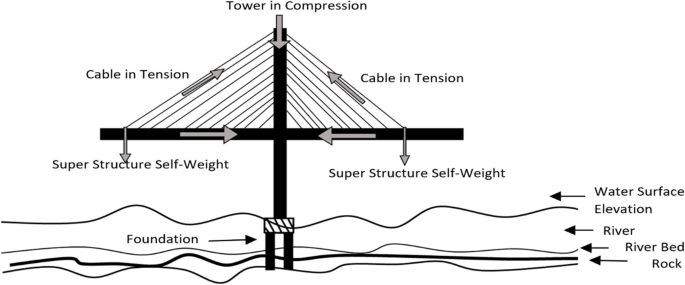
For example, in a cable-stayed bridge like the one shown below, the cables experience tension while the tower handles compression forces. Frequency analysis helps engineers ensure that these structures avoid resonance and remain stable under dynamic forces like wind or traffic loads.
Image: Usage of Frequency Analysis in Structural Design, source:aben.springeropen.com
Electrical and Control Engineering: Here, frequency analysis is not about vibrations but how circuits, filters, and control systems respond to different frequencies. Engineers use it to design stable systems and avoid signal distortion or instability.
Acoustics: By analyzing how sound waves behave at different frequencies, engineers can design systems that minimize unwanted noise in buildings, vehicles, or electronic devices.
Signal Processing: Frequency analysis plays a crucial role in telecommunications and data processing. Understanding signal behavior at various frequencies enables the design of filters, modulators, and amplifiers that ensure efficient communication.
The Significance of Frequency Analysis in Design
In the design process, frequency analysis provides engineers with essential data on how systems behave under dynamic conditions. For example, in mechanical and structural systems, frequency analysis helps predict how components respond to vibrations, enabling engineers to adjust their designs to meet safety and performance standards.
Moreover, frequency analysis is one part of the broader field of vibration analysis, which evaluates how structures and mechanical systems respond to dynamic excitation and changing operating conditions.
By studying the frequency response, engineers can identify problem frequencies that may cause undesirable effects, such as resonance or excessive oscillations, and implement measures to mitigate these risks, such as adding damping elements.
Dynamics of a Simple Pendulum
A simple pendulum is often used in theoretical studies to introduce the concept of natural frequency. While this system is rarely relevant in modern engineering applications, it demonstrates the relationship between oscillatory motion and frequency. The natural frequency of a simple pendulum depends on its length, and engineers can predict its motion accordingly.
However, in practical engineering, systems are more complex than a pendulum. Most real-world systems have more complicated interactions that require deeper analysis, such as systems with multiple degrees of freedom.
Understanding Single-Degree-of-Freedom (SDOF) Systems
In many engineering fields, such as civil, aerospace, and mechanical engineering, single-degree-of-freedom (SDOF) systems are used to model simple dynamic behavior. These systems have only one mode of vibration. They are often used to introduce the concepts of natural frequency, damping, and resonance.
Stiffness, k (N/m)
Mass, m (kg)
Natural Frequency, fₙ (Hz)
5,000
100
1.13
10,000
100
1.59
20,000
100
2.25
10,000
50
2.25
10,000
200
1.13
Example of how changes in stiffness and mass affect the natural frequency of an SDOF system
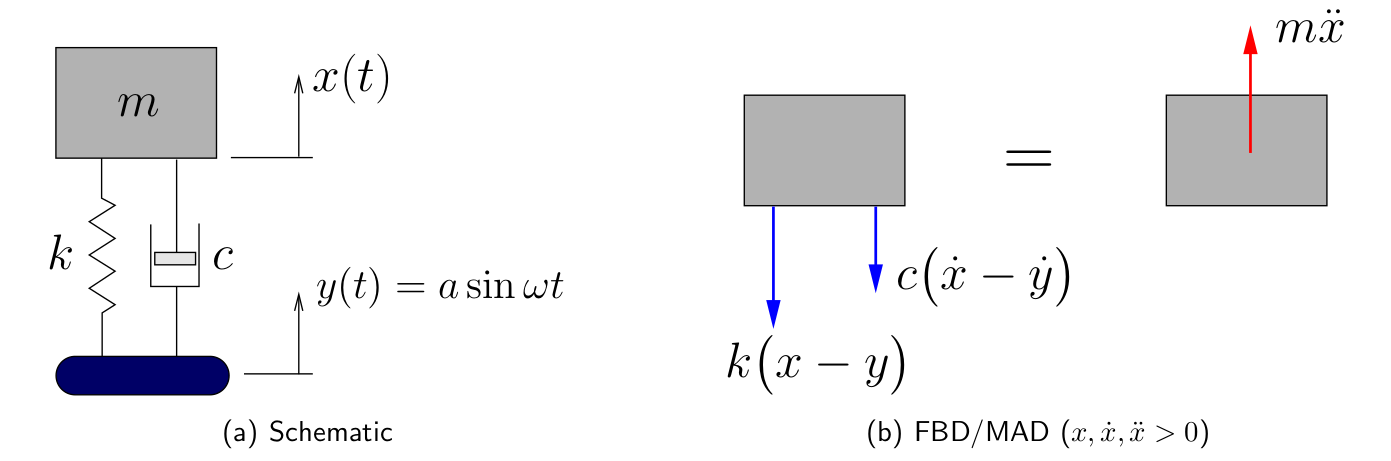
The dynamic behavior of an SDOF system is characterized by its natural frequency and the degree of damping present, which refers to the system’s ability to dissipate energy. Engineers analyze the system’s response to external forces in this context to ensure it performs as expected without excessive vibrations or instability.
A mass-spring-damper system, like the one shown below, demonstrates a typical SDOF system. This model helps engineers predict how a mechanical part will behave under vibrations and dynamic loads.
In practice, most structural systems have multiple degrees of freedom (MDOF), meaning their motion is described by multiple independent coordinates. These systems involve interconnected components whose behavior is governed by the combined mass and stiffness of the structure. Analyzing their dynamic response therefore requires methods such as finite element analysis(FEA) and modal analysis to characterize the system’s dynamic properties.
MDOF systems are more complex than single-degree-of-freedom systems because motion at one location can influence the response at others. The resulting coupling between structural components must be considered to accurately evaluate how the system responds to dynamic loading.
Decoding Response Parameters in Engineering
In structural dynamics and analysis, several response parameters are monitored to ensure the safe performance of a structure under dynamic conditions. These include:
Displacement: How much a structure moves or bends under a load.
Stress Distribution: This helps identify high-stress areas that could lead to material failure.
Natural Frequencies: Key to understanding whether the structure is at risk of resonance.
Strain and Buckling Resistance: Important for determining structural stability.
Damping: Essential for analyzing how well a structure absorbs and dissipates energy.
Engineers can optimize designs and prevent catastrophic failures due to dynamic loads by studying these parameters.
The London Millennium Bridge (2000) is a widely cited case of frequency analysis oversight. Shortly after opening, pedestrians crossing the bridge triggered a noticeable side-to-side sway. The cause traced back to lateral, not vertical, resonance: as people naturally adjusted their gait to the bridge’s swaying motion, their footsteps synchronized with it, reinforcing the movement rather than damping it out.
The bridge was closed within days and retrofitted with tuned mass and viscous dampers before reopening over a year later. The episode remains a standard reference in structural dynamics for a simple reason: the original design checks accounted for vertical vibration modes but not the lateral excitation frequencies produced by crowds walking in step. It’s a reminder that frequency analysis needs to consider the full range of directions and loading patterns a structure will actually experience, not just the ones traditionally assumed to matter.
Conclusion
Understanding the basics of frequency analysis, its use in design, and its importance in engineering helps improve the performance and reliability of systems across many fields. Whether it’s preventing resonance in structures, designing stable control systems, or ensuring efficient signal processing, frequency analysis remains vital in the engineer’s toolkit.