Structures are rarely subjected to perfectly steady loads. Machinery, rotating equipment, waves, wind, traffic, and human activity can all introduce time-varying forces that make a structure move. If these dynamic effects are not considered during design, a structure may experience excessive deformation, discomfort, noise, fatigue damage, or even structural failure.
Vibration analysis evaluates how a structure responds to such time-dependent excitation. It helps engineers identify natural frequencies, potential resonance, and the resulting structural response.
In this article, we’ll cover the fundamentals of vibration analysis, its main types, how FEA is used to simulate structural dynamic behavior, and how those results ultimately feed into standards-based structural verification.
Vibration Analysis Explanation
Vibration analysis is an engineering method used to evaluate the dynamic behavior of a structure or mechanical system when it is subjected to oscillating or time-dependent loads.
Unlike a purely static analysis, which assumes that loads are applied slowly and the structure reaches equilibrium, vibration analysis considers inertia, stiffness, damping, and the time-dependent nature of the excitation. These factors determine how a structure moves and how large its response can become.
A basic vibration problem can be described using three key properties:
Mass — determines how the structure responds to changes in motion.
Stiffness — determines how strongly the structure resists deformation.
Damping — represents mechanisms that dissipate vibrational energy.
Why Is Vibration Analysis Important in Structural Engineering?
Static structural analysis describes how a structure responds to loads under equilibrium conditions. However, many real-world loads vary with time, introducing inertia and dynamic effects that a static analysis may not capture.
These effects can occur due to periodic loading, rotating or moving equipment, wave and wind excitation, impacts and shocks, operational and seismic load, and other fluctuating or repeated dynamic loads. The resulting response depends not only on the magnitude of the load, but also on its frequency, duration, and relationship to the structure’s dynamic characteristics.
Vibration analysis helps engineers understand these effects and evaluate whether the resulting response is acceptable for the structure and its operating conditions. The main consequences engineers assess are:
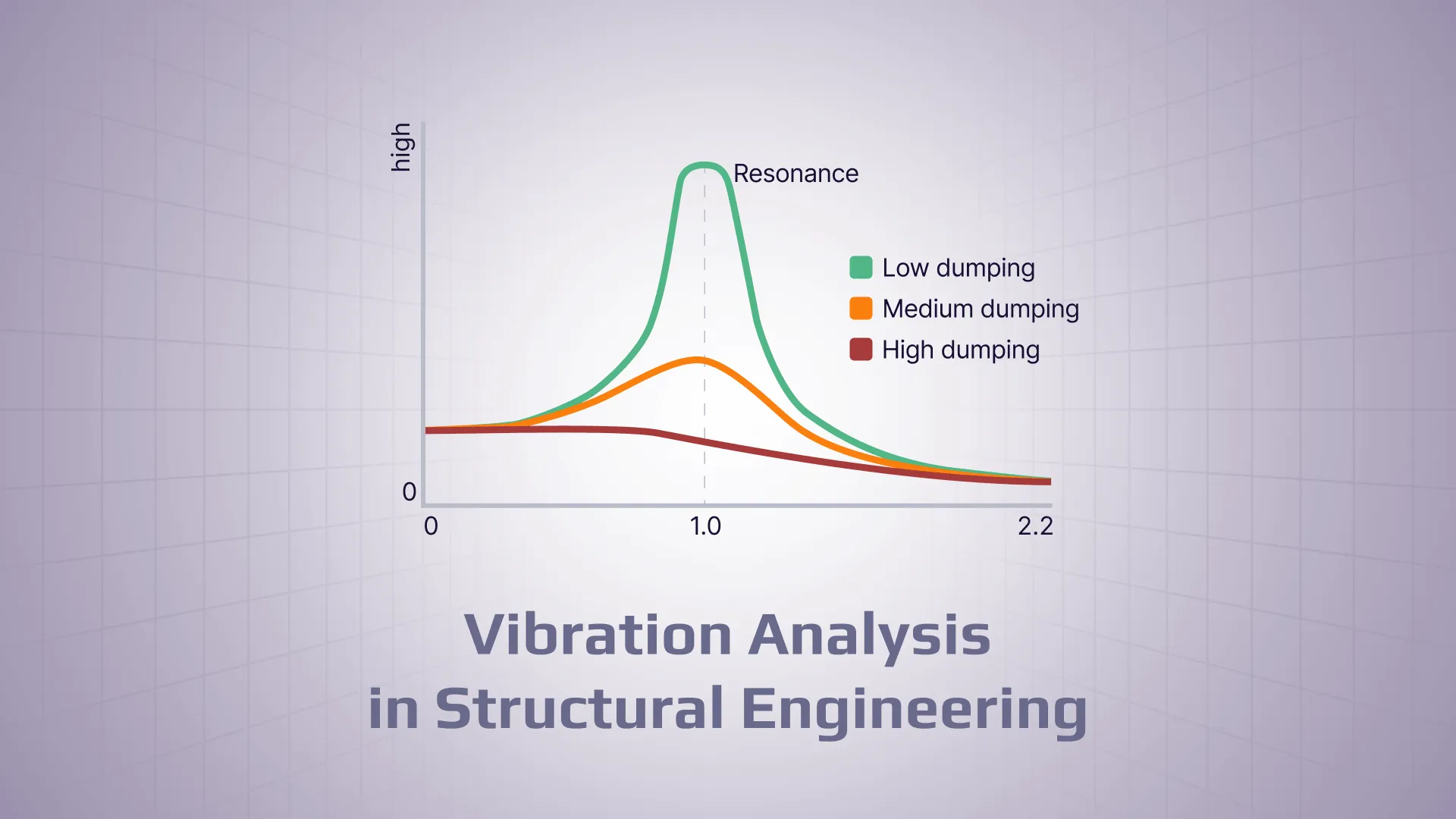
Resonance. It can amplify the structural response well beyond what the applied load alone would suggest, potentially producing much higher displacements or stresses.
Image: Dynamic amplification near resonance
Excessive deformation and vibration. Dynamic excitation can produce displacements, velocities, or accelerations that affect structural performance. Excessive motion may also influence connected components or equipment, even when the structure itself remains within its strength limits.
Fatigue. Repeated dynamic loading can produce cyclic stresses that contribute to fatigue damage over time. A structure may therefore require fatigue assessment even when individual stress levels remain below the limits considered in a static strength check.
Serviceability and equipment performance. Vibration is not only a structural strength concern. Excessive vibration can affect precision equipment, machinery operation, occupant comfort, noise levels, and connected components. For many structures, controlling vibration is therefore essential to maintaining reliable operation and acceptable service conditions. These conditions can affect bolted fasteners which may get loose due to the vibration which may lead even to lose of some of the bolts over time.
Mechanical vs Structural Vibration Analysis
In many engineering applications, mechanical vibration analysis and structural vibration analysis are closely connected because machinery and the structures supporting it can influence each other’s dynamic behavior.
Mechanical vibration analysis typically focuses on the dynamic behavior and condition of machines and their components, including rotating machinery, bearings and shafts, imbalance and misalignment, machine components, and equipment condition. It can help identify abnormal vibration behavior and support predictive maintenance by detecting changes that may indicate developing equipment problems.
Structural vibration analysis focuses on how a structure responds to dynamic excitation. Engineers may evaluate natural frequencies and mode shapes, dynamic stresses and displacements, resonance, structural fatigue, and the interaction between dynamic loads and structural behavior.
Note: Natural frequency is the specific rate at which an object or system tends to vibrate or oscillate when it is disturbed, without any external force keeping it going.
Types of Vibration Analysis
Vibration problems can be classified by how a structure is excited and how its response is evaluated. Common approaches include free and forced vibration, modal analysis, harmonic or frequency-response analysis, transient analysis, and random vibration analysis.
Free vs forced vibration. Free vibration occurs when a structure is disturbed and then allowed to vibrate without continuous external excitation; it is used to understand characteristics such as natural frequencies and mode shapes. Forced vibration occurs when an external force or prescribed motion continuously excites the structure.
Modal analysis determines a structure’s natural frequencies and mode shapes.
Harmonic / frequency-response analysis evaluates the steady-state response to sinusoidal or periodic excitation across a frequency range.
Transient vibration analysis evaluates how a structure responds over time to a changing excitation.
Random vibration analysis is used when excitation cannot be represented by a single deterministic time history or harmonic frequency.
See the comparison table below:
Analysis type
Main purpose
Typical input
Typical result
Common applications
Modal
Determine natural frequencies and mode shapes
Mass, stiffness, boundary conditions
Natural frequencies and mode shapes, displacement
Resonance screening, dynamic characterization, cross check model accuracy
Harmonic / frequency response
Determine steady-state response to periodic excitation
Frequency-dependent excitation
Response vs frequency, displacement
Machinery, rotating equipment, periodic loads
Transient
Determine response over time
Time-dependent excitation
Displacement, stress, acceleration vs time, displacement
Impact, shock, changing loads, and seismic impact
Random
Determine statistical response to random excitation
Vibration Analysis vs Modal Analysis vs Frequency Analysis
Think of these types of analysis as a hierarchy rather than a set of alternatives: vibration analysis is the broad engineering discipline; modal analysis and frequency analysis are two specific methods within it, applied at different stages of a study.
Modal analysis comes first and establishes what the structure’s dynamic characteristics are — its natural frequencies and mode shapes — independent of any specific load. Frequency-response analysis comes after, and determines how the structure actually behaves once a defined excitation is applied, using those natural frequencies as a reference point.
In practice, this means modal analysis alone can flag which modes are close to an expected operating frequency, but only frequency-response (or transient) analysis can confirm how large the resulting response actually is. The two methods are typically used together, not as substitutes for one another.
Vibration Analysis in FEA
Finite element analysis is the primary tool engineers use to quantify how a real structure will behave dynamically, since closed-form solutions are rarely practical for anything beyond simple geometries.
FEA represents a structure using finite elements and solves for its dynamic behavior based on its stiffness, mass, boundary conditions, material properties, and applied excitation. The general dynamic equilibrium equation used in structural dynamics is:
Mü + Cu̇ + Ku = F(t)
Here, M represents the mass properties of the structure, C represents damping, K represents stiffness, and F(t) represents the time-dependent excitation force. Modal analysis and frequency-response analysis, covered above, each solve a version of this equation — modal analysis with the excitation term removed, frequency-response analysis with it defined across a frequency range. The two remaining methods handle the same equation differently again:
Transient analysis represents excitation as a time history and solves for the structure’s response as it develops over time — useful for impacts, shocks, and startup or shutdown events.
Random vibration analysis instead represents excitation statistically, typically using a power spectral density (PSD), and is common for transportation, aerospace, and broadband environmental vibration problems.
Both are more specialized than modal and frequency-response analysis and are usually applied when the excitation genuinely cannot be treated as a simple time-independent or single-frequency load.
Machinery support structure. Rotating machinery can excite the supporting steel frame at its operating frequency. The engineering focus is usually the relationship between excitation frequency and natural frequency, the resulting resonance risk, and the dynamic stress and displacement produced.
Crane or lifting structure. Dynamic sources may include moving loads, machinery, operational excitation, or changes in boom configuration. Typical questions: What are the structure’s natural frequencies? Is an operating frequency close to a structural mode? What dynamic stresses or displacements occur?
Offshore or marine structure. Dynamic excitation may come from wave loading, wind, rotating equipment, or operational loads. Both global structural dynamics and local structural response may be relevant, since a locally stiff detail can still respond significantly to a globally excited mode.
The Role of FEA Software in Vibration Analysis
Running any of the analysis types above requires software capable of assembling and solving the underlying dynamic equation for a realistic structure — something that isn’t done by hand beyond the simplest cases. This is where general-purpose FEA solvers come in: they build the finite element model, apply the mass, stiffness, and boundary conditions, and solve for the requested dynamic response, whether that’s natural frequencies from a modal analysis or a full response curve from a frequency-response analysis.
Solving the dynamic equation, however, is only the first half of the engineering task. The raw output (frequencies, mode shapes, stresses, displacements) still needs to be organized, reviewed, and checked against the criteria that actually determine whether the structure is acceptable. That second half of the workflow is structural verification, and it’s a distinct step from the dynamic analysis itself.
A vibration analysis may identify a resonance risk, for example, but the engineer may still need to evaluate the resulting stresses, forces, fatigue effects, or other relevant limit states. Vibration analysis on its own does not demonstrate code compliance, it provides the input that a separate verification step then checks against a standard.
This is the gap that dedicated verification software is built to close, and it’s where SDC Verifier can help you.
Vibration Analysis in SDC Verifier
SDC Verifier is an FEA software for structural verification, which allows engineers to handle vibration analysis through its Normal Modes Analysis tool. It calculates a structure’s natural frequencies and deformation patterns and keeps that data inside the same model and workflow used for standards-based compliance checks, rather than requiring a separate handoff between solving and checking.
Image: Normal Modes Analysis in SDC Verifier
For structural verification, SDC Verifier can process supported FEA results from analyses performed in compatible FEA environments, such as transient or frequency-response analyses in Ansys Mechanical. These results can then be used for applicable standards-based checks, including fatigue assessment.
Normal Modes Setup and Execution
The workflow in SDC Verifier:
Job creation — define a calculation set containing the relevant loads and combinations.
Analysis options — select the normal modes option to compute natural frequencies and deformation shapes.
Result categories — extract displacement, stress, forces, and reaction data from the resulting modal shapes.
Selection control — restrict the analysis scope to specific parts of the model using result selections.
The SDC Verifier Normal Modes Analysis tutorial walks through this workflow end to end, from setting up the job to building modes tables and reviewing contour plots.
Common Mistakes in Vibration Analysis
Ignoring boundary conditions. Natural frequencies and mode shapes are highly dependent on how the structure is restrained.
Using an incorrect mass. Missing equipment, payload, structural components, or other relevant masses can significantly affect the calculated dynamic characteristics.
Confusing natural frequency with excitation frequency. A structure’s natural frequency is a property of the modeled system; excitation frequency describes the applied dynamic input. They are related but not interchangeable.
Treating modal analysis as a complete vibration assessment. Modal analysis identifies dynamic characteristics but does not necessarily provide the response under specific excitation.
FAQ
What is vibration analysis in engineering?
Vibration analysis is the engineering evaluation of how a structure or mechanical system responds to time-dependent, oscillating loads. It differs from general vibration monitoring or predictive maintenance, which focus on tracking a machine’s condition over time rather than predicting structural response.
What are the main types of vibration analysis?
The main types are modal, harmonic/frequency-response, transient, and random vibration analysis. Free and forced vibration describe different physical conditions rather than always corresponding to separate solver types.
What is structural vibration analysis?
It’s the evaluation of how a structure responds to dynamic excitation, covering natural frequencies, mode shapes, resonance, dynamic stresses, displacement, and other relevant response quantities.
What is the difference between modal analysis and vibration analysis?
Modal analysis is one specific type of analysis — determining natural frequencies and mode shapes — used within the broader field of vibration analysis.
What is the difference between modal analysis and frequency-response analysis?
Modal analysis determines natural frequencies and mode shapes. Frequency-response analysis evaluates the structure’s response to excitation across a frequency range.
How is FEA used in vibration analysis?
FEA represents a structure’s mass and stiffness numerically and calculates its dynamic response under appropriate boundary conditions and excitation.