SDC Verifier 2026 R2 expands structural verification with new offshore and marine standards, multiaxial fatigue analysis, improved tubular connection checks, and a new 3D View in SDC for Ansys.
The release also improves recognition, reporting, and day-to-day engineering workflows, making it easier to move from FEA results to code verification, critical-result review, and final calculation reports.
See SDC Verifier 2026 R2 in action
Explore the new standards, multiaxial fatigue capabilities, tubular connection verification, and the new 3D View in your own engineering workflow.
SDC Verifier 2026 R2 significantly extends the standards library, particularly for offshore, marine, lifting, and structural steel applications.
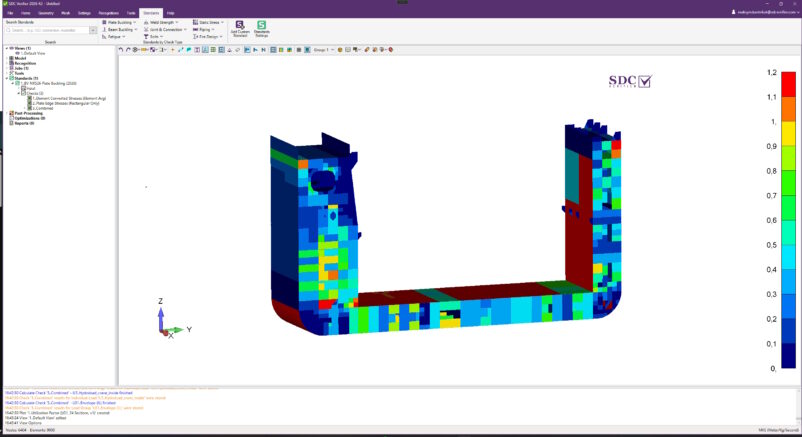
The release adds BV NR526 Plate Buckling (2026), API RP 2A-LRFD Connections (2nd Edition, 2019), and ISO 19902 Connections (2nd Edition, 2020). It also expands the existing AS 4100 Members (2020) implementation and introduces a workflow for models containing both flat and curved plates.
The check is built around sections and plates recognized from the FE model. Panel Finder can automatically identify panels and determine their dimensions, while material properties, plate thickness, stresses, and safety factors are used directly in the verification.
Engineers can control how stresses are evaluated, including the use of plate-edge stresses, plate-average stresses, or element-level stresses.
Stress conversion into the required plate directions is also handled automatically before the buckling check is performed.
This matters because a plate buckling calculation depends not only on stress magnitude, but also on plate geometry, orientation, thickness, and the direction in which stresses act. Bringing those inputs into one workflow reduces the amount of data that needs to be reconstructed manually outside the FE model.
The implementation is intended for flat plates. Curved plates are detected and excluded from this specific check rather than being evaluated using a flat-panel methodology.
API RP 2A-LRFD Connections (2nd Edition, 2019)
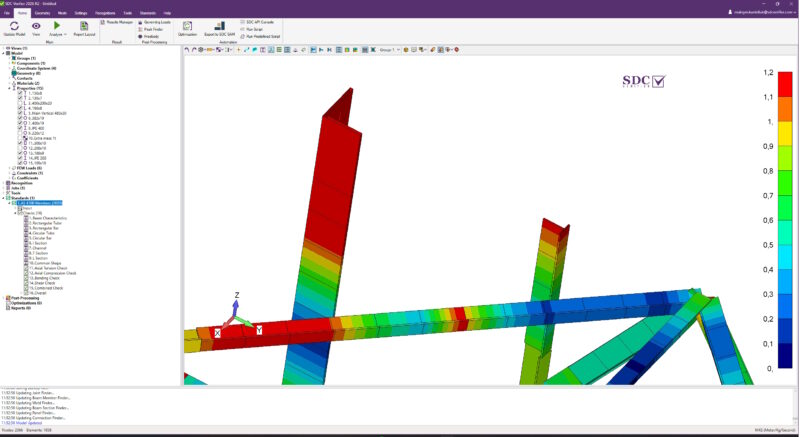
The new API implementation enables tubular connection verification according to API RP 2A-LRFD, 2nd Edition, November 2019, Chapter 14.
The calculation works with connections recognized by Connection Finder, including chord and brace geometry.
Brace classification determines whether the brace contribution is treated as K, TY, or Cross in the joint-strength calculation. The check also uses information such as brace effective lengths, chord cans, axial forces, bending moments, and material properties.
The practical benefit is that the connection calculation remains tied to the recognized structural model rather than requiring engineers to rebuild individual joints separately for code verification.
The implementation covers the strength assessment of tubular joints using recognized connection geometry, brace classification, material properties, and forces extracted from the structural model.
It also accounts for areas such as chord-force effects, chord cans, critical joints, and overlapping-joint conditions.
Together, the new API and ISO implementations substantially expand the available verification routes for offshore tubular structures.
AS 4100 Members (2020)
The existing AS 4100 Members (2020) implementation has been extended with support for T-sections and equal-leg angle sections.
The standard can now cover tension, compression, bending, shear, and combined actions for a wider range of steel member geometries.
Beam Member Finder provides the member-length data required by the calculation, while standard-specific parameters such as residual stresses, lateral restraint, moment modification factors, section constants, and capacity factors remain configurable.
Flat and curved plate buckling in the same model
R2 also improves how mixed plate geometries can be handled.
Instead of trying to force both geometries into the same calculation method, the relevant buckling methodology can be applied to each plate type within the same verification workflow.
Multiaxial fatigue according to DNV-RP-C203
One of the largest new engineering capabilities in SDC Verifier 2026 R2 is the Multiaxial Fatigue Tool.
The tool provides the data required for multiaxial fatigue assessment according to DNV-RP-C203 Fatigue, October 2024, Chapter 5.6.
Traditional fatigue workflows are relatively straightforward when the relevant stress components change proportionally throughout the loading history.
The problem becomes more complicated when normal and shear stresses change independently and the principal stress direction rotates during the load cycle.
R2 distinguishes between these two loading conditions.
For proportional loading, the principal stress direction remains essentially constant. Rainflow counting can therefore be applied to the relevant directional stress channels.
For non-proportional loading, the relationship between the stress components changes throughout the load history. Independent rainflow counting would lose the actual phase relationship between normal and shear stresses.
In this case, SDC Verifier uses a master-slave approach. Normal stress perpendicular to the weld toe acts as the master series, while the corresponding shear-stress ranges are determined over the same time intervals.
This keeps the normal and shear components connected to the same physical load cycle rather than treating them as unrelated histories.
Engineers can configure the load history, hysteresis filtering, number of bins, half-cycle calculation, principal-angle tolerance, treatment of nested load groups, and the part of the model to process.
The result is not simply another fatigue-result table. R2 adds the stress-history processing required to prepare FE results for the multiaxial fatigue methods defined in DNV-RP-C203.
Better brace and tubular connection verification
The release also strengthens the connection-verification workflow underneath the new API and ISO standards.
The Brace Stress Tool now calculates both elastic and plastic buckling stresses. Both stress types can be used by supported standards.
The ISO, API, and NORSOK connection standards have also been updated to support plastic buckling stresses.
Brace Stress Tool calculates axial, in-plane bending, and out-of-plane bending stresses using the forces at the joint together with cross-sectional properties such as area and section moduli.
This matters because a tubular connection cannot always be assessed in isolation from the brace connected to it.
Brace capacity, buckling behavior, joint geometry, and forces at the connection all contribute to the final verification.
R2 therefore improves the consistency between brace-level calculations and connection-level checks instead of treating them as separate engineering problems.
The release also improves the handling of overlap conditions in Joint Check tables, addressing another important case in tubular connection assessment.
New 3D View in SDC for Ansys
R2 introduces the first version of 3D View in SDC for Ansys.
The new view is designed to improve performance and visualization when working with SDC Criteria Plots and Contour Plots for load and check results. The first iteration is available as a BETA feature.
For engineers working with large and complex models, result visualization is part of the verification process itself. Engineers need to move quickly between the complete structure, critical regions, individual checks, and the FE results behind them.
The new 3D View provides a more responsive environment for inspecting SDC results directly in the Ansys workflow and creates a foundation for further visualization improvements.
Separately, SDC for Ansys can now generate plots without requiring a solved solution in Mechanical. This allows SDC plotting workflows to be used even when a solved Mechanical solution is not present.
Recognition, reporting, and everyday workflows
Not every important improvement in R2 is a new engineering formula.
A second group of changes focuses on how engineers find standards, recognize structural objects, review results, and turn verification data into reports.
A better Standards workflow
As the standards library grows, finding the correct check becomes a usability problem of its own.
R2 introduces an updated Standards tab on the ribbon.
Standards are now organized by check type and can be searched by parameters including name, industry, year, country, and check type.
That makes it possible to search directly for a standard or application instead of navigating through an increasingly large standards hierarchy.
The change is relatively simple, but it becomes more valuable with every new code implementation added to SDC Verifier.
Recognition information in Report Designer
R2 also brings more recognition data directly into Report Designer.
Information from Beam Section Finder, Connection Finder, and Joint Finder can now be used in reports.
This shortens the path between identifying structural objects in the FE model, performing verification on those objects, and documenting them in the final calculation report.
Panel Finder has also been expanded to support predefined girders modelled with plate elements. These girders can now be included in Panel Finder settings and plate recognition.
Weld Finder improvements
Managing recognized welds becomes easier in R2.
Weld Finder now supports renaming multiple welds, improved selection, and better sorting. The Weld and Weld Parts tables have also been redesigned to display more relevant information.
These are primarily workflow improvements, but they become significant on large models containing hundreds or thousands of recognized structural objects.
Camera position, model styles, and other view settings can therefore be preserved while reviewing peak results.
Views selected using Apply to Selected can also be used for Model Plots in Report Designer.
This helps keep the visual presentation consistent between engineering review and the final report.
Compatibility, performance, and smaller usability improvements
SDC Verifier 2026 R2 adds compatibility with Femap 2606 and Simcenter 3D 2606.
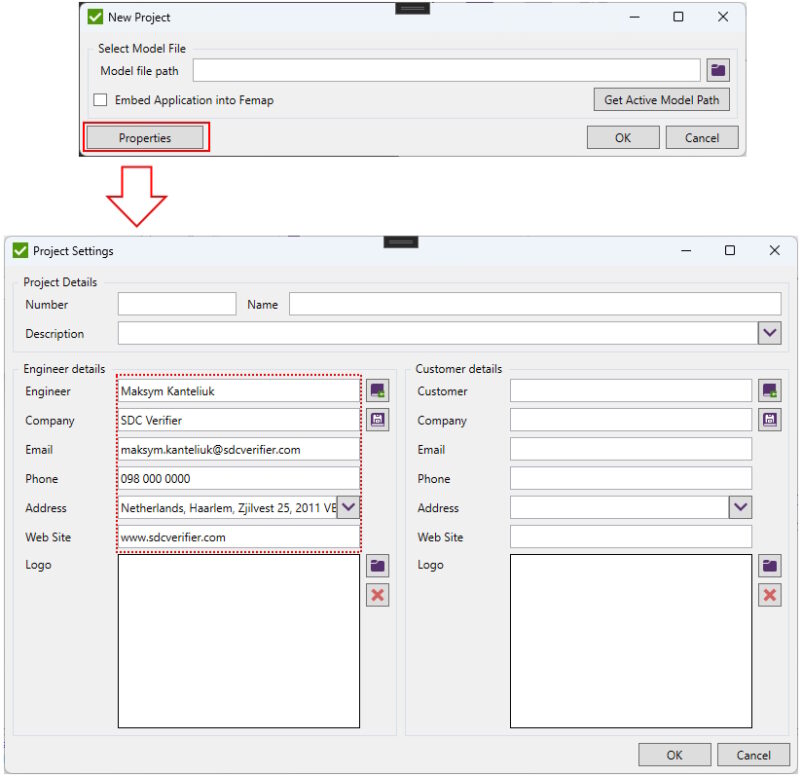
Project creation has also been simplified by synchronizing engineer information from the user account instead of requiring the same data to be entered repeatedly.
The toolbar now includes Undo and Redo, and SDC Verifier can optionally launch automatically after installation.
Background logging has been changed to improve responsiveness while other windows are open.
The Effective Plate Width Tool now follows the selected display-unit system, while plate and cross-section thickness display has been simplified.
R2 also improves performance when building Expand Tables for fatigue checks.
The release also introduces a No-Solver license module for standalone SDC Verifier. It provides a licensing option for users who need standalone SDC Verifier functionality without an analysis solver license.
This is primarily a licensing change, not a new solver-independent verification workflow. If analysis results are already available, the underlying verification, post-processing, and reporting workflow remains fundamentally the same.
These changes are individually smaller than a new standard or fatigue methodology, but together they remove friction from repeated engineering tasks.
Calculation correctness and stability
R2 also contains a substantial group of calculation and result-processing fixes.
The release includes corrections to Eurocode 3 Members, API RP 2A-WSD pile calculations, API RP 2A-LRFD connection calculations, Hot Spot Stress calculations for solid elements, and several result-reading cases in Ansys and Simcenter 3D.
Recognition fixes cover areas including Connection Finder, Panel Finder, Joint Finder, brace gaps, duplicated elements, and coordinate-system determination in Weld Summation Tool.
The release also addresses crashes, autosave and Save As behavior, Report Designer issues, visibility problems, and other stability and usability cases.
For engineering verification software, these changes are not secondary.
Adding more standards expands what engineers can verify. Maintaining calculation correctness, stable result reading, and reliable recognition determines whether those checks can be used consistently in production workflows.
What SDC Verifier 2026 R2 changes in practice
SDC Verifier 2026 R2 expands the number of engineering problems that can be handled within the same verification environment while reducing the number of manual transitions between model data, code calculations, result review, and reporting.
Offshore and marine engineers gain broader plate buckling and tubular connection code coverage.
Fatigue workflows gain support for multiaxial loading according to DNV-RP-C203.
Tubular structures gain deeper brace and connection verification capabilities.
SDC for Ansys gains a new 3D result-viewing environment, while recognition data becomes more useful downstream in calculation reports and everyday model-management workflows require less manual setup.
The direction is consistent across the release: use the structural model and its results as the basis for verification, recognize the engineering objects that matter, apply the required design-code checks, identify governing results, and carry that information into a traceable calculation report without rebuilding the same data in separate tools.
That is the main change in SDC Verifier 2026 R2.
Put SDC Verifier 2026 R2 to work on your next project
Verify complex structures against industry standards, review critical results directly from your FEA model, and generate traceable engineering reports in one workflow.